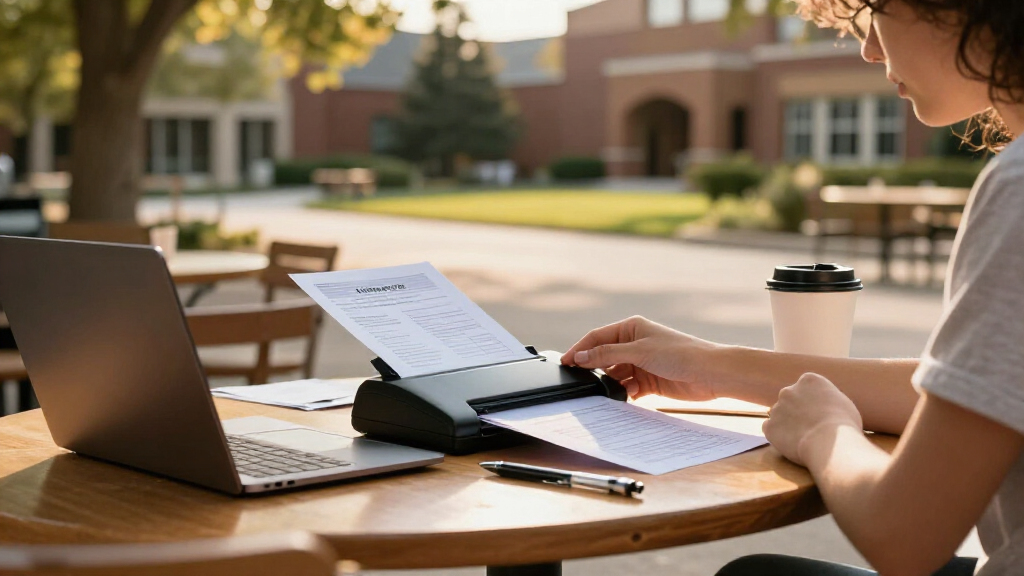
Choosing the right compact document scanners for students requires balancing portability with scanning speed, a tradeoff that defines this category. The Brother DS-640 stands out as the best overall pick for most students due to its incredible size-to-performance ratio, fitting easily into a backpack while handling double-sided scans. For those needing higher volume, the ScanSnap iX1300 offers superior speed and software integration, though it demands more desk space and a higher budget. Students must decide if they need a device for occasional receipts and notes or daily textbook digitization. This guide breaks down the specific strengths and limitations of fourteen models to help you avoid buying a scanner that is either too bulky for campus life or too slow for exam season.

Prime made for students and young adults
- Fast, free delivery for dorm and study essentials
- Prime Video and Amazon Music included
- Member-only deals
Key Takeaways
- Portability vs. Feeder Capacity: Ultra-compact handheld models like the AOZBZ save space but lack automatic document feeders, forcing manual page-by-page scanning which slows down large batches.
- Software Ecosystems Matter: Fujitsu’s ScanSnap models justify their premium price through intuitive mobile apps that auto-crop and index files, a feature often missing in budget handheld units.
- Duplex Scanning is a Time Saver: Students scanning double-sided lecture notes or textbooks benefit heavily from models like the Epson DS-C330 that scan both sides simultaneously, cutting wait times in half.
- Power Source Flexibility: Many desktop scanners require wall outlets, whereas USB-powered models like the Epson WorkForce ES-50 run off laptops, offering greater flexibility in libraries or cafes without power strips.
- Resolution Needs Are Lower Than Advertised: While 600+ DPI is marketed, most student workflows involving text recognition (OCR) perform adequately at 300 DPI, making ultra-high-resolution handhelds less of a priority than speed.
| AOZBZ Handheld Document Scanner, 300/600/900 DPI, with 16 GB SD Card |  | Best for Scanning Away from a Desk | Scanner type: Document | Scanning resolutions: 300, 600, and 900 dpi | Connection: USB 2.0 | VIEW LATEST PRICE | See Our Full Breakdown |
| ScanSnap iX2500 Wireless or USB High-Speed Document Scanner, Black |  | Best for High-Volume Student Workflows | Scanner type: Business card, document | Connection: USB-C, Wi-Fi 6 | Resolution: 600 dpi | VIEW LATEST PRICE | See Our Full Breakdown |
| Canon CanoScan LiDE 300 Slim Scanner |  | Best for Flatbed Photo and Page Scans | Scanner type: Document, photo | Connectivity: USB | Optical resolution: 2400 × 2400 dpi | VIEW LATEST PRICE | See Our Full Breakdown |
| Brother DS-640 Compact Mobile Document Scanner |  | Best for Laptop-Based Portability | Model: DS-640 | Scan speed: Up to 16 ppm | Connection: USB | VIEW LATEST PRICE | See Our Full Breakdown |
| ScanSnap iX1300 Wireless or USB Double-Sided Color Document Scanner, Black |  | Best Compact Duplex Feeder | Scanner type: Document, receipt | Connection: USB, Wi-Fi | Resolution: 600 dpi | VIEW LATEST PRICE | See Our Full Breakdown |
| Epson WorkForce ES-400 II Duplex Desktop Document Scanner |  | Best for High-Volume Coursework | Scanner Type: Color duplex document scanner | Connection: USB | Resolution: 300 dpi | VIEW LATEST PRICE | See Our Full Breakdown |
| Canon imageFORMULA R10 Portable Document Scanner |  | Best Balance of Portability and Speed | Scanner Type: Portable Document Scanner | Connection: USB | Resolution: 600 dpi | VIEW LATEST PRICE | See Our Full Breakdown |
| Epson DS-C330 Compact Desktop Document Scanner |  | Best for Small Desks | Scanner Type: Compact desktop document scanner | Design: Vertical | ADF Capacity: 20 pages | VIEW LATEST PRICE | See Our Full Breakdown |
| HPPS100 Portable USB Document and Photo Scanner |  | Best Ultra-Portable Option | Scanner Type: Sheetfed document scanner | Connection: USB 2.0 | Resolution: 1200 dpi | VIEW LATEST PRICE | See Our Full Breakdown |
| Brother DS-640e Compact Portable Document Scanner |  | Best for Modern Connectivity | Scanner Type: Business card and document | Connection: USB-C | Scan Speed: Up to 16 ppm | VIEW LATEST PRICE | See Our Full Breakdown |
| Epson WorkForce ES-C220 Compact Duplex Document Scanner |  | Best Balance of Speed and Portability | Scanning Speed: Up to 30 ppm / 60 ipm | ADF Capacity: 20 sheets | Resolution: 300 dpi | VIEW LATEST PRICE | See Our Full Breakdown |
| ScanSnap iX2400 One-Touch Color Document Scanner, Black |  | Best for Heavy Batch Scanning | Scanning Speed: Up to 45 pages per minute | ADF Capacity: 100 sheets | Resolution: 600 dpi | VIEW LATEST PRICE | See Our Full Breakdown |
| Canon imageFORMULA DR-C225 II Office Document Scanner |  | Best Space-Saving Desktop Design | Scanning Speed: Up to 25 pages per minute | ADF Capacity: 30 sheets | Optical Resolution: 600 dpi | VIEW LATEST PRICE | See Our Full Breakdown |
| Epson WorkForce ES-50 Portable Document Scanner |  | Best Ultra-Portable Option | Weight: 9.44 ounces | Dimensions: 10.7 × 10.7 × 1.3 inches | Resolution: 1200 dpi | VIEW LATEST PRICE | See Our Full Breakdown |
| compact document scanners for student | Dimensions | Weight | Connection | Resolution |
|---|---|---|---|---|
| AOZBZ Handheld Document Scanne | 10 × 1 × 1 in | 170 g | USB 2.0 | — |
| ScanSnap iX2500 Wireless or US | 6.26 × 11.5 × 6.34 in | 7.7 lb | USB-C, Wi-Fi 6 | 600 dpi |
| Canon CanoScan LiDE 300 Slim S | 14.5 × 9.9 × 1.7 in | 3.6 lb | — | — |
| Brother DS-640 Compact Mobile | 1.99 × 11.9 × 1.45 in | 1 lb | USB | 300 dpi |
| ScanSnap iX1300 Wireless or US | 4.5 × 11.7 × 3.3 in | 4.4 lb | USB, Wi-Fi | 600 dpi |
| Epson WorkForce ES-400 II Dupl | 11.6 × 11.6 × 6.9 in | 3.7 kg | USB | 300 dpi |
| Canon imageFORMULA R10 Portabl | 3.74 × 11.22 × 1.57 in | 998 g | USB | 600 dpi |
| Epson DS-C330 Compact Desktop | — | — | — | — |
| HPPS100 Portable USB Document | 2 × 11.6 × 1.4 in | 3 oz | USB 2.0 | 1200 dpi |
| Brother DS-640e Compact Portab | 2 x 11.9 x 1.45 inches | 1 pound | USB-C | 300 dpi |
| Epson WorkForce ES-C220 Compac | 4.1 × 11.7 × 4.9 in | 3.9 lbs | USB | 300 dpi |
| ScanSnap iX2400 One-Touch Colo | 6.26 x 11.5 x 6.34 in | 7.1 lbs | USB | 600 dpi |
| Canon imageFORMULA DR-C225 II | 6.1 × 11.8 × 8.7 in | 6 lb | USB | — |
| Epson WorkForce ES-50 Portable | 10.7 × 10.7 × 1.3 inches | 9.44 ounces | — | 1200 dpi |
More Details on Our Top Picks
AOZBZ Handheld Document Scanner, 300/600/900 DPI, with 16 GB SD Card
When a student needs to capture a page in a library book or a handout without carrying a feeder scanner, the AOZBZ’s handheld format is its main advantage. It saves JPEG or PDF scans directly to the included 16 GB card, so a computer is not needed during capture. Its 300, 600, and 900 dpi settings give some control over file detail, though higher resolution can mean larger files. Compared with the Brother DS-640, this wand is less dependent on a laptop while scanning, but it lacks the Brother’s stated page-per-minute speed and supported computer workflow. The tradeoff is manual technique: I have to move it steadily over each page, which can produce uneven results, especially on long documents. Its listed OS support is also dated, so check compatibility before buying.
Pros:- Handheld, 170 g design is easy to carry in a backpack.
- Scans directly to microSD, including the supplied 16 GB card.
- Offers 300, 600, and 900 dpi settings.
- Saves files as JPEG or PDF.
Cons:- Manual movement over each page takes practice and can lead to uneven captures.
- Listed compatibility covers older Windows and Mac OS versions, so newer systems may require checking.
- No stated automatic document feeder or page-per-minute speed for handling large batches.
Best for: Students who occasionally need to capture book pages or loose notes away from a desk and want scans saved to removable storage.
Not ideal for: Students digitizing long packets or needing consistent, fast scans; the wand must be moved manually, and the listed operating-system compatibility is limited to older versions.
- Scanner type:Document
- Scanning resolutions:300, 600, and 900 dpi
- Connection:USB 2.0
- File formats:JPEG, PDF
- Storage:MicroSD cards up to 32 GB; 16 GB card included
- Dimensions:10 × 1 × 1 in
- Weight:170 g
- Compatibility:Windows XP/7/Vista; Mac OS 10.4 or later
Our verdict“Choose the AOZBZ for occasional, computer-free page capture on the go, not for reliably digitizing a semester’s worth of papers.”
ScanSnap iX2500 Wireless or USB High-Speed Document Scanner, Black
The ScanSnap iX2500 is the batch-work pick here: its 100-sheet feeder and 45-page-per-minute duplex scanning can turn a stack of lecture notes into files far faster than the 20-sheet ScanSnap iX1300. Wi-Fi 6 and USB-C give students options for sending scans to computers, phones, and cloud services, while touchscreen profiles and automatic naming can cut down on repetitive setup. That capacity and automation make the most sense in a shared study space or for a student who routinely handles large paper loads. The compromise is size and weight: at 7.7 pounds, it is much less convenient to carry between classes than the one-pound Brother DS-640. Its 100-sheet feeder still needs reloading for especially large jobs, and app or cloud features depend on compatible services and devices.
Pros:- Scans both sides at up to 45 pages per minute.
- 100-sheet feeder supports larger batches than the ScanSnap iX1300.
- Wi-Fi 6 and USB-C enable flexible computer, mobile, and cloud connections.
- Touchscreen profiles and automatic file handling can reduce repetitive organization.
Cons:- At 7.7 pounds, it is a poor fit for frequent backpack transport.
- The 100-sheet feeder still needs reloading for batches beyond its capacity.
- Some cloud and app functions rely on compatible services or devices.
Best for: Students, research assistants, or shared study groups that regularly digitize large batches of double-sided notes and want wireless or USB-C workflows.
Not ideal for: Students who need a scanner to carry between classes or have very limited desk space; it weighs 7.7 pounds and is larger than the mobile options.
- Scanner type:Business card, document
- Connection:USB-C, Wi-Fi 6
- Resolution:600 dpi
- Sheet capacity:100 sheets
- Scanning speed:Up to 45 pages per minute, double-sided
- Color depth:24-bit
- Dimensions:6.26 × 11.5 × 6.34 in
- Weight:7.7 lb
- Compatibility:Mac, PC, iOS, Android
Our verdict“Pick the iX2500 when batch speed and automated organization matter more than portability or a small desk footprint.”
Canon CanoScan LiDE 300 Slim Scanner
For students who scan photos, book pages, receipts, and loose sheets rather than feeding long stacks, the Canon CanoScan LiDE 300 offers a different kind of flexibility from the lineup’s sheet-fed models. Its flatbed captures at up to 2400 × 2400 dpi, while Auto Scan Mode adjusts settings to the media and four EZ buttons put common tasks, including searchable PDF creation, within easy reach. That makes it a better match for fragile or irregular originals than the Brother DS-640, which is designed to pull media through a compact scanner. The cost of that versatility is pace: the LiDE 300 has a standard sheet capacity of one, so every page needs individual placement. USB-only connectivity and the listed Windows 7 minimum system requirement also make it less flexible for students who want wireless or broad, current-device support.
Pros:- Flatbed design suits photos and other originals that are awkward to feed.
- Optical resolution reaches 2400 × 2400 dpi, with fade correction and dust reduction.
- Auto Scan Mode and four EZ buttons simplify common scan and copy tasks.
- Supports searchable PDFs with OCR and sending scans to cloud services.
Cons:- One-page-at-a-time placement makes large document batches slow.
- USB-only connectivity offers less flexibility than the Wi-Fi ScanSnap models.
- Listed minimum system requirements specify Windows 7, so students should check current-device support.
Best for: Students who need a compact desk scanner for photos, book pages, receipts, and individual documents, with OCR-ready PDF options.
Not ideal for: Students who regularly scan multi-page packets or need wireless operation; each original is placed individually and connection is USB only.
- Scanner type:Document, photo
- Connectivity:USB
- Optical resolution:2400 × 2400 dpi
- Color depth:48-bit
- Media types:Photo, receipt, business card, paper
- Dimensions:14.5 × 9.9 × 1.7 in
- Weight:3.6 lb
- Buttons:4 EZ buttons
Our verdict“Choose the LiDE 300 if photo and book-page handling matters more than batch speed or wireless convenience.”
Brother DS-640 Compact Mobile Document Scanner
The Brother DS-640 suits students who want a practical middle ground between the AOZBZ handheld wand and a desktop feeder. At one pound and powered through USB, it is built for a laptop bag, yet its stated speed of up to 16 pages per minute is better suited to ordinary document batches than manually sweeping a wand across each page. It also handles receipts, business cards, and plastic ID cards, and its software supports OCR and cloud destinations. Unlike the wireless ScanSnap iX1300, the DS-640 must stay connected to a computer, so it is not a standalone capture tool for a phone. Its 300 dpi resolution is aimed at everyday document work rather than high-detail image capture, and image rotation is available on PC only. This is portability with a computer attached, not a self-contained workflow.
Pros:- One-pound body is easier to carry than the 3.6-pound Canon LiDE 300.
- USB connection also provides power, reducing the need for a separate power supply.
- Handles paper, receipts, business cards, and several types of plastic cards.
- Includes software for OCR, image enhancement, email, and cloud scanning.
Cons:- Requires a connected computer and compatible software to operate.
- 300 dpi resolution is less suited to high-detail image capture than the Canon LiDE 300.
- Image rotation is available on PC only.
Best for: Students who carry a laptop and want a lightweight, USB-powered scanner for notes, receipts, IDs, and occasional document batches.
Not ideal for: Students who want to scan directly from a phone or work without a connected computer; it is USB-dependent and image rotation is PC-only.
- Model:DS-640
- Scan speed:Up to 16 ppm
- Connection:USB
- Resolution:300 dpi
- Supported media:Business cards, embossed cards, ID cards, laminated cards, plain paper, plastic cards, receipts
- Maximum document length:72 in
- Dimensions:1.99 × 11.9 × 1.45 in
- Weight:1 lb
- Compatibility:Windows, Mac, Linux
Our verdict“Choose the DS-640 if you want a light, laptop-powered document scanner and do not need wireless or computer-free scanning.”
ScanSnap iX1300 Wireless or USB Double-Sided Color Document Scanner, Black
The ScanSnap iX1300 is the more balanced feeder choice for a student who wants duplex scanning without giving up a compact desk footprint. It scans both sides at up to 30 pages per minute, and automatic deskew, color optimization, and blank-page removal help turn class notes into cleaner digital files. Its 20-sheet capacity is a clear step below the iX2500’s 100-sheet feeder, but that smaller batch size pairs with a 4.4-pound body and dimensions suited to a crowded desk. USB and Wi-Fi support computers and mobile devices, unlike the computer-dependent Brother DS-640. The tradeoff is that this remains a feeder scanner, not a flatbed: the Canon CanoScan LiDE 300 is the better fit for delicate photos or pages that cannot be fed. For routine coursework, the iX1300 balances speed, footprint, and connectivity.
Pros:- Compact 4.4-pound design takes less space than the ScanSnap iX2500.
- Duplex scanning reaches up to 30 pages per minute.
- USB and Wi-Fi support computers and mobile devices.
- Automatic deskew, color optimization, and blank-page removal reduce cleanup work.
Cons:- 20-sheet capacity means larger batches require reloading.
- Feeder design is less suitable than the Canon CanoScan LiDE 300 for fragile or bound originals.
- The listed warranty is a one-year depot warranty.
Best for: Students with a small desk who regularly scan double-sided notes and want wireless or USB access from computers and mobile devices.
Not ideal for: Students who need to process very large batches without reloading or scan fragile, bound, or irregular originals that are better suited to a flatbed.
- Scanner type:Document, receipt
- Connection:USB, Wi-Fi
- Resolution:600 dpi
- Standard sheet capacity:20 sheets
- Scanning speed:Up to 30 ppm duplex
- Media types:Paper
- Dimensions:4.5 × 11.7 × 3.3 in
- Weight:4.4 lb
- Warranty:1-year depot warranty
Our verdict“Pick the iX1300 for compact, wireless duplex scanning of routine coursework, but choose the iX2500 for larger batches.”
Epson WorkForce ES-400 II Duplex Desktop Document Scanner
This scanner stands out for students managing heavy digitization tasks like scanning entire textbooks or stacks of lecture notes. Compared to the ultra-portable Canon imageFORMULA R10, the ES-400 II offers a 50-sheet automatic document feeder and significantly faster speeds at 35 pages per minute, making it ideal for batch processing. While it lacks the wireless convenience of the ScanSnap iX2500, its robust CCD sensor delivers superior image quality for archival purposes. The tradeoff is its footprint and weight; it is not a device you will casually toss into a backpack daily. However, for a dorm room setup where space is available, its ability to handle searchable PDFs and editable files streamlines study organization effectively.
Pros:- High-speed duplex scanning reduces wait times for large batches.
- Large 50-sheet ADF minimizes manual intervention during long sessions.
- CCD sensor technology provides accurate color reproduction for diagrams.
- Advanced software features like blank page skip and auto-crop save editing time.
Cons:- Bulky form factor limits true portability.
- USB-only connection restricts setup flexibility compared to wireless models.
- Heavier weight makes it difficult to transport frequently.
Best for: Graduate students or researchers who need to digitize large volumes of printed material quickly and prioritize image fidelity over portability.
Not ideal for: Students with limited desk space or those who need a scanner they can easily carry between classes and coffee shops.
- Scanner Type:Color duplex document scanner
- Connection:USB
- Resolution:300 dpi
- ADF Capacity:50 sheets
- Scanning Speed:Up to 35 pages per minute
- Dimensions:11.6 × 11.6 × 6.9 in
- Weight:3.7 kg
Our verdict“Choose this if you scan hundreds of pages weekly and have a dedicated study desk.”
Canon imageFORMULA R10 Portable Document Scanner
The R10 occupies a sweet spot between the ultra-thin HPPS100 and the bulkier Epson DS-C330. At under a kilogram, it is light enough for a backpack yet sturdy enough to handle a 20-sheet automatic feeder. This capacity allows for efficient scanning of multi-page contracts or syllabi without constant reloading, a clear advantage over the single-sheet HPPS100. Its USB-powered design eliminates the need for external power bricks, keeping your bag organized. While it lacks the wireless features of the ScanSnap iX1300, its physical footprint is smaller, and it does not rely on battery charging. The main drawback is its CIS sensor, which may struggle with highly textured paper compared to the CCD sensors in larger desktop units.
Pros:- USB bus-powered operation simplifies setup and reduces cable clutter.
- 20-sheet ADF allows for batch scanning of short documents.
- Compact dimensions fit easily into standard student backpacks.
- Duplex scanning captures both sides of a page in a single pass.
Cons:- CIS sensor may miss details on uneven or thick paper surfaces.
- Requires a computer connection; no standalone scanning capability.
- Not suitable for photograph-quality scanning on glossy media.
Best for: Students who need a reliable, dual-sided scanner that fits in a laptop bag and handles multi-page documents efficiently.
Not ideal for: Users who require wireless connectivity or those who need to scan fragile, thick, or textured art materials.
- Scanner Type:Portable Document Scanner
- Connection:USB
- Resolution:600 dpi
- ADF Capacity:20 sheets
- Scanning Speed:Up to 12 pages per minute
- Dimensions:3.74 × 11.22 × 1.57 in
- Weight:998 g
Our verdict“A pragmatic choice for students who want speed and duplex scanning without carrying a heavy device.”
Epson DS-C330 Compact Desktop Document Scanner
When desk real estate is at a premium, the vertical design of the DS-C330 is its defining feature. Unlike the horizontal layout of the Canon imageFORMULA R10, this scanner takes up minimal footprint, making it ideal for cramped dorm desks. It supports one-pass duplex scanning at speeds comparable to larger office machines, ensuring you don’t sacrifice efficiency for space. While the Epson WorkForce ES-400 II offers a larger feeder, the DS-C330’s ability to handle long receipts and passports adds versatility for students managing finances or travel docs. The tradeoff is the 20-page feeder limit, which may require more frequent reloading during massive scans. It also lacks the wireless freedom of the ScanSnap iX2500, relying on USB connectivity.
Pros:- Vertical orientation minimizes desk footprint significantly.
- Handles long documents up to 120 inches, useful for receipts.
- Fast duplex scanning speed of 60 images per minute.
- Includes staple protection to prevent damage during feeding.
Cons:- 20-page ADF requires frequent reloading for large batches.
- USB-only connection limits placement away from the computer.
- Peak duty cycle is lower than heavy-duty office models.
Best for: Students with very limited desk space who still need the speed of a dedicated duplex scanner for daily tasks.
Not ideal for: Those who need to scan large batches of documents (over 20 pages) in a single go or require wireless mobility.
- Scanner Type:Compact desktop document scanner
- Design:Vertical
- ADF Capacity:20 pages
- Scanning Speed:Up to 30 ppm / 60 ipm
- Max Document Size:8.5 × 120 inches
- Daily Duty Cycle:5,000 pages
- Software:Epson Document Capture Pro
Our verdict“The go-to choice for tight workspaces where horizontal scanners simply do not fit.”
HPPS100 Portable USB Document and Photo Scanner
If your priority is absolute minimalism, the HPPS100 is the lightest option in this lineup, weighing just 3 ounces. It is significantly smaller than the Brother DS-640e and the Canon R10, making it easy to lose in a large bag. However, this portability comes at a cost: it is a simplex scanner, meaning you must flip pages manually to scan both sides. This contrasts sharply with the duplex capabilities of the Epson DS-C330, doubling the time for double-sided documents. It is best suited for quick, one-off scans of receipts or single-page handouts. The high 1200 dpi resolution is beneficial for capturing detail from small text or photos, but the lack of an automatic feeder means it cannot handle multi-page stacks efficiently.
Pros:- Extremely lightweight and compact for true pocketability.
- High 1200 dpi resolution captures fine details well.
- USB-powered design requires no extra power sources.
- HP WorkScan software offers basic editing and auto-crop tools.
Cons:- Simplex-only scanning requires manual flipping for double-sided pages.
- No automatic document feeder; sheets must be fed one by one.
- Slower overall workflow for multi-page documents compared to duplex models.
Best for: Students who only need to scan single-page items like receipts or handouts and prioritize weight over speed.
Not ideal for: Users who need to scan double-sided documents or multi-page papers frequently.
- Scanner Type:Sheetfed document scanner
- Connection:USB 2.0
- Resolution:1200 dpi
- Scanning Speed:Up to 15 pages per minute
- Sheet Capacity:1
- Dimensions:2 × 11.6 × 1.4 in
- Weight:3 oz
Our verdict“Ideal for occasional, single-sided scanning where every ounce saved in your bag matters.”
Brother DS-640e Compact Portable Document Scanner
The DS-640e distinguishes itself with USB-C connectivity, a modern standard that aligns with newer laptops used by many students. Unlike the Canon R10 or HPPS100 which rely on older USB-A ports, this model reduces the need for dongles. It offers a balance of portability and functionality, scanning at 16 pages per minute with a single-sheet feed. While it lacks the duplex capability of the Epson DS-C330, its software suite includes robust OCR features for making text searchable, which is valuable for study materials. The 1-pound weight is heavier than the HPPS100 but still portable. The primary limitation is the single-sheet capacity, which makes scanning multi-page documents tedious compared to models with automatic feeders.
Pros:- USB-C connection offers modern compatibility and power delivery.
- Includes OCR software for converting scans to editable text.
- Compact form factor is easy to transport in a bag.
- Supports long documents up to 72 inches for receipts.
Cons:- Single-sheet feeding requires manual intervention for multi-page jobs.
- No duplex scanning; must flip pages manually for double-sided docs.
- Software and drivers require an internet connection for initial setup.
Best for: Students using modern USB-C laptops who need a compact scanner with strong text recognition software.
Not ideal for: Those who need to scan double-sided documents or large batches of papers quickly.
- Scanner Type:Business card and document
- Connection:USB-C
- Scan Speed:Up to 16 ppm
- Resolution:300 dpi
- Wattage:2.5 watts
- Dimensions:2 x 11.9 x 1.45 inches
- Weight:1 pound
Our verdict“A solid choice for students with modern hardware who prioritize text searchability over batch speed.”
Epson WorkForce ES-C220 Compact Duplex Document Scanner
This model stands out for students who need to digitize lecture handouts or contracts quickly without sacrificing desk space. Its duplex scanning captures both sides of a page in one pass, which saves significant time compared to single-pass models like the Epson WorkForce ES-50. The 20-page automatic document feeder allows for batch processing, making it far more efficient than manual feed options. However, the software ecosystem requires an internet connection for initial setup, which can be a hurdle for those in restricted campus networks. While it handles standard documents well, passport scanning requires an optional carrier sheet, adding a small friction point for international students. It is a robust middle-ground choice for those who scan regularly but still value portability.
Pros:- Duplex scanning in a single pass increases productivity
- Lightweight design fits easily into a backpack
- 20-sheet ADF supports efficient batch scanning
- Software includes useful image correction tools
Cons:- Requires optional accessory for passport scanning
- Software setup depends on internet connectivity
Best for: Students who scan multi-page documents regularly and need duplex capability without a bulky footprint.
Not ideal for: Users who need to scan passports immediately out of the box or those without reliable internet for software installation.
- Scanning Speed:Up to 30 ppm / 60 ipm
- ADF Capacity:20 sheets
- Resolution:300 dpi
- Dimensions:4.1 × 11.7 × 4.9 in
- Weight:3.9 lbs
- Connection:USB
- Max Document Length:120 in
Our verdict“This scanner is the ideal choice for students who prioritize speed and duplex features over extreme portability.”
ScanSnap iX2400 One-Touch Color Document Scanner, Black
This device is built for the student with a massive backlog of paperwork, such as a law student or a researcher. The 100-sheet automatic document feeder dwarfs the capacity of the Epson WorkForce ES-C220, allowing you to scan entire stacks of readings in one go. With speeds reaching 45 pages per minute, it processes documents faster than most competitors in this class. The tradeoff is size and weight; at 7.1 lbs, it is not something you will want to carry to class daily. Additionally, it relies on a wired USB connection, limiting flexibility compared to wireless alternatives. It is a powerhouse for desk-bound digitization rather than mobile use.
Pros:- Huge 100-sheet ADF minimizes reloading time
- High-speed scanning at 45 pages per minute
- Automatic detection of document size and orientation
- Robust software for organizing scanned files
Cons:- Heavy and bulky for frequent transport
- Wired USB connection only
- Higher power consumption than portable models
Best for: Graduate students or researchers who need to digitize large volumes of documents rapidly on a fixed desk.
Not ideal for: Undergraduates who need a lightweight scanner to carry between classes or dorms.
- Scanning Speed:Up to 45 pages per minute
- ADF Capacity:100 sheets
- Resolution:600 dpi
- Dimensions:6.26 x 11.5 x 6.34 in
- Weight:7.1 lbs
- Connection:USB
- Supported Media:Documents, photos, receipts, ID cards
Our verdict“Choose this scanner if you prioritize high-volume throughput and have a dedicated workspace for your equipment.”
Canon imageFORMULA DR-C225 II Office Document Scanner
For students with cramped dorm desks, this scanner’s upright design is a significant advantage. It occupies less horizontal surface area than the wider ScanSnap iX2400, leaving room for textbooks and laptops. Duplex scanning at 25 pages per minute is respectable, though slightly slower than Epson’s faster models. The 30-sheet ADF is a middle ground, offering more batch capacity than single-feed scanners but less than high-end office units. A notable benefit is the three-year warranty, providing peace of mind for long-term use. However, it is still tethered by USB and lacks the extreme portability of the Epson ES-50, making it best suited for a semi-permanent study station.
Pros:- Vertical footprint saves valuable desk space
- Duplex scanning capability
- Handles varied media including thick paper and cards
- Includes a three-year manufacturer warranty
Cons:- Slower scanning speed than top-tier competitors
- ADF capacity is limited to 30 sheets
- No wireless connectivity options
Best for: Students with limited desk space who need a reliable, upright scanner for occasional batch jobs.
Not ideal for: Users who need to scan more than 30 pages at a time or require wireless connectivity.
- Scanning Speed:Up to 25 pages per minute
- ADF Capacity:30 sheets
- Optical Resolution:600 dpi
- Dimensions:6.1 × 11.8 × 8.7 in
- Weight:6 lb
- Warranty:Three years
- Connection:USB
Our verdict“This is the smart pick for students who need to maximize their small desk area without compromising on duplex features.”
Epson WorkForce ES-50 Portable Document Scanner
This scanner is unmatched in portability, weighing just 9.44 ounces and fitting in a jacket pocket. Unlike the heavier Canon imageFORMULA DR-C225 II, the ES-50 is powered entirely by USB, eliminating the need for power bricks or batteries. It is ideal for grabbing a single receipt, ID card, or handout on the go. However, it feeds one sheet at a time, making it inefficient for digitizing entire chapters of a textbook. The 1200 dpi resolution ensures crisp text, but the lack of an automatic document feeder is a hard constraint for bulk scanning. It complements a desktop scanner rather than replacing one for heavy users.
Pros:- Extremely lightweight and compact form factor
- USB-powered with no external power supply needed
- High 1200 dpi resolution for clear text
- Handles long documents and small cards
Cons:- Single-sheet feed prevents batch scanning
- Slower than ADF-equipped models for multiple pages
Best for: Mobile students who need to scan single pages, receipts, or IDs while away from their desk.
Not ideal for: Anyone who needs to scan multi-page documents or large batches of papers quickly.
- Weight:9.44 ounces
- Dimensions:10.7 × 10.7 × 1.3 inches
- Resolution:1200 dpi
- Power:USB-powered; 2.1 watts
- Max Document Size:8.5 × 72 inches
- Scanning Speed:As little as 5.5 seconds per page
- Connectivity:USB 2.0
Our verdict“This is the go-to scanner for students who prioritize extreme portability and single-page capture over speed and volume.”
How We Picked
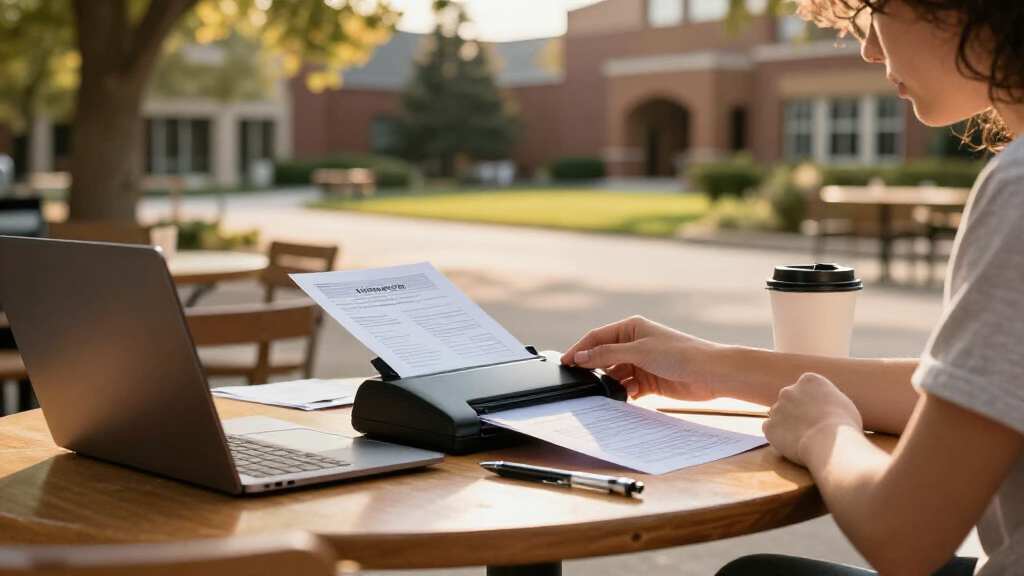
My selection process for this roundup prioritized the unique constraints of student life: limited desk space, tight budgets, and the need for mobility. I evaluated each scanner based on its physical footprint relative to its throughput capabilities, ensuring that ‘compact’ did not come at the cost of frustratingly slow manual feeding. I also weighed the ease of software setup, as students rarely have time to troubleshoot driver conflicts or complex network configurations. Models were ranked higher if they offered seamless cloud integration or simple USB plug-and-play functionality, which reduces friction for users who just want to scan and study.
Furthermore, I considered the versatility of media types. A scanner that only handles standard letter paper might fail a student needing to digitize receipts, ID cards, or small notebooks. I penalized devices with poor build quality or flimsy paper paths that jam frequently, as reliability is paramount when you are on a deadline. The final ranking reflects a balance between initial cost, long-term usability, and the ability to fit into a standard student backpack without dominating the available space.
| compact document scanners for student | Connection |
|---|---|
| AOZBZ Handheld Document Scanne | USB 2.0 |
| ScanSnap iX2500 Wireless or US | USB-C, Wi-Fi 6 |
| Canon CanoScan LiDE 300 Slim S | — |
| Brother DS-640 Compact Mobile | USB |
| ScanSnap iX1300 Wireless or US | USB, Wi-Fi |
| Epson WorkForce ES-400 II Dupl | USB |
| Canon imageFORMULA R10 Portabl | USB |
| Epson DS-C330 Compact Desktop | — |
| HPPS100 Portable USB Document | USB 2.0 |
| Brother DS-640e Compact Portab | USB-C |
| Epson WorkForce ES-C220 Compac | USB |
| ScanSnap iX2400 One-Touch Colo | USB |
| Canon imageFORMULA DR-C225 II | USB |
| Epson WorkForce ES-50 Portable | — |
Factors to Consider When Choosing Compact Document Scanners For Students
Selecting a scanner goes beyond just looking at the DPI spec. You need to match the device’s mechanics to your actual scanning habits. Here are the critical factors to weigh before making a purchase.
Automatic Document Feeders vs. Flatbed/Handheld
The biggest differentiator in this category is how the paper enters the machine. Automatic Document Feeders (ADF), found on models like the Brother DS-640, allow you to stack ten pages and walk away, which is ideal for digitizing entire chapters or stacks of printed handouts. In contrast, handheld scanners like the AOZBZ require you to manually draw the device across each page. While handhelds are smaller and cheaper, the time cost of scanning fifty pages one by one can be prohibitive during exam prep. If you scan more than ten pages weekly, an ADF model is worth the extra bulk and cost to preserve your study time.
Connectivity: Wi-Fi vs. USB Power
Students often move between dorm rooms, libraries, and cafes. Wi-Fi-enabled scanners like the ScanSnap iX2500 offer the freedom to scan from a tablet or phone without tethering to a laptop, which is convenient for reviewing notes on the go. However, Wi-Fi models require battery charging or a constant power source. USB-powered scanners like the Epson ES-50 draw power directly from your laptop, eliminating the need for wall outlets but tying up a USB port. Consider your typical workflow: if you scan primarily at a desk, USB is simpler; if you scan in varied locations with limited power access, battery-powered Wi-Fi models provide necessary independence.
Software Integration and OCR Quality
Scanning is only useful if you can search the text later. Premium models invest heavily in Optical Character Recognition (OCR) software that creates searchable PDFs automatically. Budget handheld scanners often produce raw image files that require separate, often paid, OCR software to make text searchable. This hidden cost and workflow step can frustrate students. Look for scanners that include native cloud integration with services like Evernote, OneNote, or Google Drive. This automation saves hours of manual file management, allowing you to focus on studying rather than organizing digital folders.
Paper Handling and Jam Resistance
Student documents are often imperfect: dog-eared pages, staples left in handouts, or thin receipt paper. Low-cost scanners frequently struggle with mixed media, leading to frequent jams that halt your workflow. Higher-end compact models feature more robust paper paths and sensors that detect misfeeds before they cause damage. I recommend checking if the scanner supports mixed-size feeding if you plan to scan receipts alongside standard letter-sized notes. A scanner that jams every third page is not compact in time savings, regardless of its physical size.
Durability and Build Quality for Travel
A device labeled ‘portable’ will inevitably be thrown into a backpack alongside heavy textbooks and laptops. Plastic-heavy designs may crack under this pressure, whereas models with reinforced housings or folding mechanisms designed for travel withstand daily abuse better. Check the weight and shape; a scanner that is too wide may not fit in standard laptop sleeves. The Canon imageFORMULA R10 is a good example of a device designed with a narrow footprint specifically to slide into tight spaces. Prioritize build integrity over aesthetic features, as a broken scanner is useless during finals week.
Frequently Asked Questions
Do I really need a duplex scanner, or is single-sided enough?
You should choose a duplex scanner if you frequently scan double-sided lecture notes, textbooks, or printed articles. Duplex scanning captures both sides of the page in one pass, which cuts the time in half and ensures pages stay in the correct order. Single-sided scanners require you to flip the stack manually, which is tedious and prone to errors. Given that most academic materials are printed on both sides, the slight increase in cost for a duplex model like the Epson DS-C330 pays off in time saved during high-volume periods like final exams.
Can handheld scanners replace flatbed scanners for student needs?
Handheld scanners work well for quick captures of receipts, ID cards, or single pages, but they struggle with volume. They lack the automatic document feeder that makes batch scanning efficient. If your primary use case is digitizing a few pages a week, a handheld model is sufficient and cost-effective. However, for digitizing entire notebooks or large stacks of handouts, the manual effort required by handhelds becomes a significant bottleneck. I recommend handhelds only as a secondary device or for students with very low scanning volume.
Is Wi-Fi necessary for a student scanner?
Wi-Fi is a convenience feature, not a requirement, but it significantly improves usability in a dorm setting. It allows you to scan directly to a phone or tablet without needing to open your laptop, which is helpful when reviewing notes in bed or at a cafe. However, Wi-Fi scanners often require more complex initial setup and may have connectivity issues in crowded student networks. If you prefer a ‘plug-and-play’ experience and always scan at your desk, a USB-only model is more reliable and often cheaper, avoiding potential network troubleshooting headaches.
How does DPI affect my file sizes and storage?
Higher DPI (dots per inch) results in sharper images but exponentially larger file sizes. For student purposes, scanning at 300 DPI is the sweet spot, providing enough clarity for OCR text recognition and readability without consuming excessive cloud storage or laptop space. Scanning at 600 or 900 DPI is generally unnecessary for text documents and can slow down the transfer process over Wi-Fi. I advise setting your scanner to 300 DPI for standard documents and only increasing it for detailed diagrams or photographs, keeping your digital library manageable and fast.
Which scanner is best for scanning receipts and credit cards?
You need a scanner with a dedicated card slot or a flexible paper path that can handle rigid, small items without jamming. Models like the ScanSnap iX1300 often include specific guides or settings for business cards and receipts, ensuring they feed correctly. Standard desktop scanners may struggle with small items, causing them to slip or jam. If you track expenses for a part-time job or budgeting, prioritize a model with explicit support for small media scanning to avoid the frustration of manual feeding or repeated failed attempts.
Conclusion
Choosing the right scanner depends on your specific workflow and budget. For most students, the Brother DS-640 is the best overall choice, offering the perfect balance of portability, duplex speed, and ease of use for daily lecture notes. If you have a higher budget and need premium software integration and speed for heavy volume, the ScanSnap iX1300 is the superior premium pick. For those on a strict budget or with minimal scanning needs, the Canon CanoScan LiDE 300 provides reliable flatbed quality at a lower entry price, though it lacks portability. If you are new to scanning and want the simplest setup, the Epson WorkForce ES-50 offers a user-friendly interface and compact design that rarely requires troubleshooting. Evaluate your volume, mobility needs, and software preferences to make the final decision.