Eyeshine is easy to recognize and surprisingly easy to misread. That sudden glint in a night photograph can look like a tiny lamp switched on inside an animal’s head. In fact, the effect begins with light entering the eye, reflecting from a specialized layer, and finding its way back toward the observer. Follow the path carefully and a fleeting flash becomes a lesson in anatomy, optics, and the limits of what a camera can tell us.

Prime made for students and young adults
- Fast, free delivery for dorm and study essentials
- Prime Video and Amazon Music included
- Member-only deals
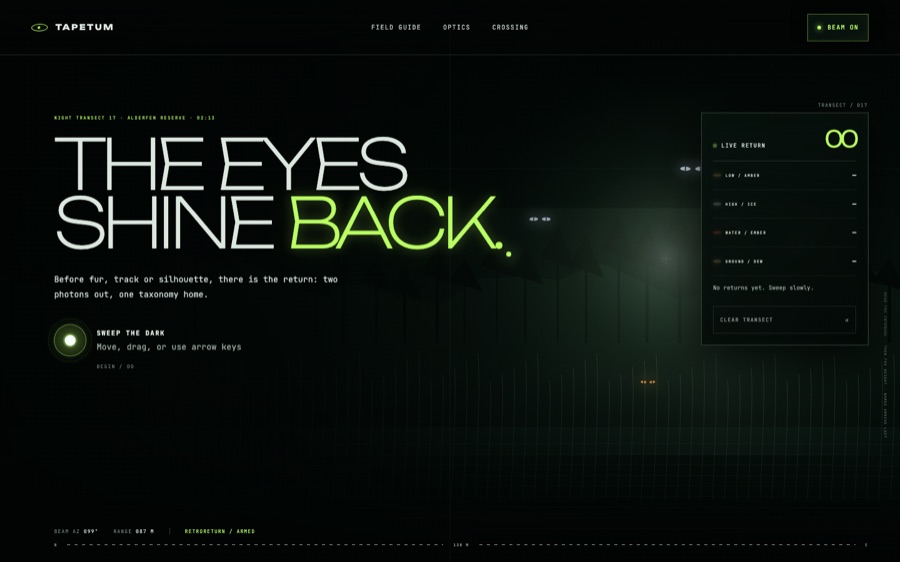
“Tapetum Lucidum — Night Survey 17” turns that lesson into a field guide for the curious. Its case study follows the making of a code-only eyeshine scene: how layered surfaces suggest a living eye, how a controlled palette evokes darkness without burying the details, and how small shifts in reflection change the impression from specimen to stare. The result invites readers to look closely at a familiar phenomenon and ask what, exactly, they are seeing.
For educators, science readers, and anyone who has paused over a pair of bright eyes in the dark, the project offers a useful bridge between biological explanation and visual craft. The full case study traces the decisions behind the effect, from the first light cue to the final uncanny glimmer—and reveals the detail that makes the gaze feel alive.
Read the full design teardown → · Visit the live room
Popular right now

Dyson Airwrap i.d. Multi-Styler for Straight and Wavy Hair

Bose QuietComfort Wireless Noise Cancelling Headphones, Sandstone

De'Longhi 15-Bar Pump Espresso Machine with Milk Frother & Temperature Control
As an affiliate, we earn on qualifying purchases.