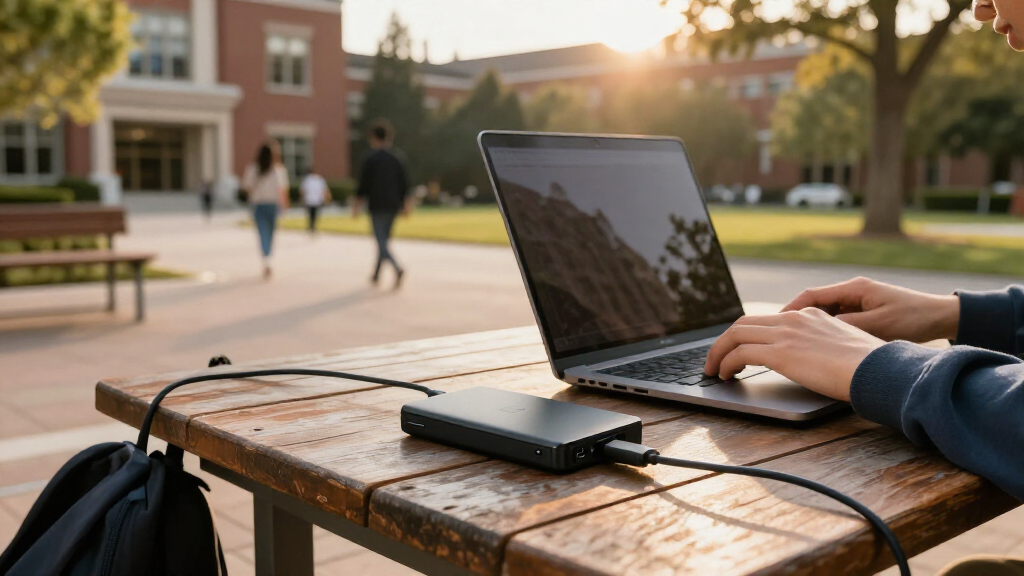
The Samsung T7 Portable SSD 1TB is my best overall pick for most students, balancing useful capacity, a familiar USB-C connection, and a straightforward everyday role. The SanDisk Extreme Portable SSD 1TB is a stronger fit for students who carry a drive outdoors or between busy campus days, while the Verbatim Pocket 512GB stands out for its compact size. The main tradeoffs are capacity versus portability, and paying for speed that your computer may not support. Small 250GB drives can handle documents and a light project load, but large video, design, and research libraries call for more room. Read on for the full comparison and guidance on matching a drive to your classes and devices.

Prime made for students and young adults
- Fast, free delivery for dorm and study essentials
- Prime Video and Amazon Music included
- Member-only deals
Key Takeaways
- The Samsung T7 1TB is the clearest all-around student choice in this group: it offers a practical capacity and a simpler everyday proposition than models whose appeal depends on specialized speed or ruggedness.
- SanDisk’s Extreme models separate by capacity and workload: the 1TB version suits students who value a more durable carry-around drive, while the 2TB version better fits large media libraries and longer projects.
- 250GB models are niche picks, not universal campus drives. They can suit document-heavy coursework or a tight backup routine, but video, design files, and multiple semesters of work can quickly make that capacity restrictive.
- High advertised transfer speeds matter only when the whole setup supports them. The Samsung T9 and SanDisk Extreme models may appeal to demanding workflows, but a compatible computer and cable are needed to benefit from their faster interfaces.
- Several names in the lineup signal overlapping everyday roles: the SanDisk Portable SSD options and WD My Passport SSD and Go models call for careful comparison of capacity, connection, and physical design rather than choosing by brand alone.
| SanDisk 1TB Portable SSD, Black |  | Best Overall for Everyday Student Carry | Capacity: 1 TB | Read speed: Up to 800 MB/s | Interface: USB 3.2 Gen 2 (USB-C) | VIEW LATEST PRICE | See Our Full Breakdown |
| Western Digital 1TB My Passport Go SSD Portable External Storage, Cobalt |  | Best for Low-Fuss Backpack Carry | Capacity: 1 TB | Read speed: Up to 400 MB/s | Interface: USB 3.0 | VIEW LATEST PRICE | See Our Full Breakdown |
| Vansuny 250GB Portable External SSD, USB 3.1 Gen2, Metal USB-C Mini Solid State Drive |  | Best Starter Drive for Small Backups | Capacity: 250 GB | Read speed: Up to 430 MB/s | Write speed: Up to 350 MB/s | VIEW LATEST PRICE | See Our Full Breakdown |
| Netac ZSlim 250GB Portable SSD |  | Best Lightweight Pick for Quick Transfers | Capacity: 250 GB | Read speed: Up to 550 MB/s | Write speed: Up to 450 MB/s | VIEW LATEST PRICE | See Our Full Breakdown |
| SanDisk Extreme Portable SSD, 1TB, Up to 2000MB/s |  | Best Premium Pick for Large Creative Projects | Capacity: 1 TB | Maximum read speed: Up to 2,000 MB/s | Interface: USB 3.0 | VIEW LATEST PRICE | See Our Full Breakdown |
| SSK Portable SSD 250GB External Solid State Drive USB-C |  | Best Lightweight Pick for Small Projects | Capacity: 250 GB | Interface: USB 3.2 Gen 2, USB-C and USB-A | Read speed: Up to 1050 MB/s | VIEW LATEST PRICE | See Our Full Breakdown |
| SanDisk 2TB Extreme Portable SSD |  | Best for Rugged, High-Capacity Carry | Capacity: 2 TB | Interface: USB 3.2 Gen 2 | Read speed: Up to 1050 MB/s | VIEW LATEST PRICE | See Our Full Breakdown |
| Verbatim Pocket 512GB External SSD, USB 3.2 Gen 2, Up to 1000MB/s |  | Best Carry Kit for Everyday Coursework | Capacity: 512 GB | Interface: USB 3.2 Gen 2 | Connectivity: USB-C | VIEW LATEST PRICE | See Our Full Breakdown |
| Samsung T9 Portable SSD 1TB, USB 3.2 Gen 2×2, Up to 2,000 MB/s | 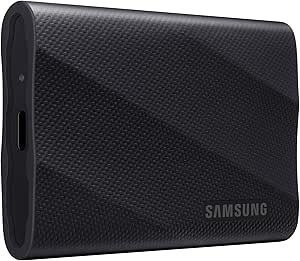 | Best for Speed-Heavy Creative Work | Capacity: 1 TB | Interface: USB 3.2 Gen 2×2 | Read speed: Up to 2000 MB/s | VIEW LATEST PRICE | See Our Full Breakdown |
| Western Digital 1TB My Passport SSD Portable External Solid State Drive |  | Best Balanced 1TB Pick | Capacity: 1 TB | Interface: USB 3.2 Gen 2 | Connectors: USB-C and USB-A; adapter included for older systems | VIEW LATEST PRICE | See Our Full Breakdown |
| SanDisk 500GB Portable SSD, Up to 1000MB/s Read Speed |  | Best Lightweight Daily Carry | Storage capacity: 500 GB | Interface: USB 3.0 | Connector: USB Type-C | VIEW LATEST PRICE | See Our Full Breakdown |
| ADATA SD810 500GB Portable External SSD |  | Best for Tough Conditions and Fast Compatible Ports | Capacity: 500 GB | Interface: USB 3.2 Gen 2×2 (USB-C) | Read speed: Up to 2000 MB/s | VIEW LATEST PRICE | See Our Full Breakdown |
| Samsung T7 Portable SSD 1TB Titan Gray | 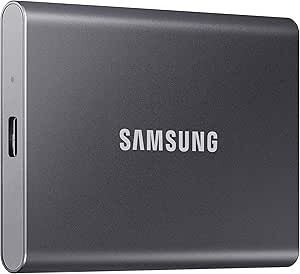 | Best Overall for Campus Coursework | Capacity: 1 TB | Interface: USB 3.2 Gen 2 | Read speed: Up to 1050 MB/s | VIEW LATEST PRICE | See Our Full Breakdown |
| Samsung T5 Portable SSD 500GB, USB 3.1 External Solid State Drive, Blue |  | Best for Older Devices and Basic Backups | Capacity: 500 GB | Interface: USB 3.1 | Read speed: Up to 540 MB/s | VIEW LATEST PRICE | See Our Full Breakdown |
| SanDisk 1TB Portable SSD, USB-C, Black |  | Best Capacity for a Lightweight Budget Setup | Capacity: 1 TB | Read speed: Up to 600 MB/s | Connectivity: USB Type-C | VIEW LATEST PRICE | See Our Full Breakdown |
| portable solid state drives for student | Capacity | Interface | Read speed | Compatibility |
|---|---|---|---|---|
| SanDisk 1TB Portable SSD | 1 TB | USB 3.2 Gen 2 (USB-C) | Up to 800 MB/s | Laptops, tablets, Xbox Series S |
| Western Digital 1TB My Passpor | 1 TB | USB 3.0 | Up to 400 MB/s | Mac, PC, Sony PlayStation 4 |
| Vansuny 250GB Portable Externa | 250 GB | USB 3.1 Gen 2 (USB-C) | Up to 430 MB/s | Windows, Mac OS, Android |
| Netac ZSlim 250GB Portable SSD | 250 GB | USB 3.2 Gen 2 | Up to 550 MB/s | — |
| SanDisk Extreme Portable SSD | 1 TB | USB 3.0 | — | — |
| SSK Portable SSD 250GB Externa | 250 GB | USB 3.2 Gen 2, USB-C and USB-A | Up to 1050 MB/s | PC, Mac, Linux, iPhone, Android, PlayStation 5 |
| SanDisk 2TB Extreme Portable S | 2 TB | USB 3.2 Gen 2 | Up to 1050 MB/s | — |
| Verbatim Pocket 512GB External | 512 GB | USB 3.2 Gen 2 | Up to 1000 MB/s | — |
| Samsung T9 Portable SSD 1TB | 1 TB | USB 3.2 Gen 2×2 | Up to 2000 MB/s | — |
| Western Digital 1TB My Passpor | 1 TB | USB 3.2 Gen 2 | Up to 1050 MB/s | Windows 10/8.1, macOS Big Sur/Catalina/Mojave/High Sierra |
| SanDisk 500GB Portable SSD | — | USB 3.0 | — | Desktop, laptop, smartphone, and tablet; Mac and PC |
| ADATA SD810 500GB Portable Ext | 500 GB | USB 3.2 Gen 2×2 (USB-C) | Up to 2000 MB/s | Windows, Mac, Xbox Series X, PlayStation 5, and Nintendo Switch |
| Samsung T7 Portable SSD 1TB Ti | 1 TB | USB 3.2 Gen 2 | Up to 1050 MB/s | PC, Mac, Android, and gaming consoles |
| Samsung T5 Portable SSD 500GB | 500 GB | USB 3.1 | Up to 540 MB/s | Windows 7+, Mac OS X 10.9+, and Android 4.4+ |
| SanDisk 1TB Portable SSD | 1 TB | — | Up to 600 MB/s | Mac, PC, desktop, laptop, smartphone, and tablet |
More Details on Our Top Picks
SanDisk 1TB Portable SSD, Black
For students who want a roomy drive that can handle daily trips between home, campus, and class, this 1TB SanDisk is the most balanced choice in this group. Its read speeds reach 800 MB/s, a useful step up from the Western Digital My Passport Go’s 400 MB/s when moving larger course folders or media projects. The two-meter drop protection and rubber attachment hook also make it easier to secure to a backpack than a bare, pocket-sized drive. The tradeoff is that its write speeds are lower than its stated read speed, and actual performance depends on the connected device. Students who need the fastest transfers or water and dust resistance should compare it with the SanDisk Extreme Portable SSD, while those with light storage needs can carry a smaller-capacity option.
Pros:- 1TB capacity leaves room for coursework, backups, and media files.
- Up to 800 MB/s read speed is faster than the Western Digital My Passport Go’s stated 400 MB/s.
- Up to two-meter drop protection helps with everyday bag carry.
- Rubber hook offers a way to attach the drive to a backpack or belt.
Cons:- Write speeds are lower than the advertised read speed.
- Actual transfer performance depends on the host device and interface conditions.
- The product is identified as an older model in listings.
Best for: Students who carry a laptop between classes and need 1TB for lecture files, project folders, and regular backups.
Not ideal for: Students who transfer large video projects constantly or need rated water and dust resistance; the faster SanDisk Extreme Portable SSD is a better fit for those demands.
- Capacity:1 TB
- Read speed:Up to 800 MB/s
- Interface:USB 3.2 Gen 2 (USB-C)
- Drop protection:Up to 2 meters
- Enclosure material:Rubber
- Color:Black
- Compatibility:Laptops, tablets, Xbox Series S
Our verdict“Choose this SanDisk for a practical mix of 1TB capacity, useful transfer speed, and bag-friendly protection for everyday student use.”
Western Digital 1TB My Passport Go SSD Portable External Storage, Cobalt
The My Passport Go is the pick for students who value a drive that is ready to connect without a separate cable in the pencil case. Its built-in cable reduces the chance of arriving at a study session with the drive but no way to plug it in, and its rubber bumper provides up to two-meter drop resistance. That makes it a more convenient carry than the Vansuny 250GB, which includes separate cable and adapter pieces. The compromise is speed: its 400 MB/s read rate trails the SanDisk 1TB Portable SSD’s 800 MB/s, and the USB 3.0 interface lacks newer USB-C connectivity. Its 1TB capacity suits broad student use, but students who move large media files often may prefer a faster drive; those wanting a simple, self-contained backup option have a clearer reason to choose this one.
Pros:- Built-in cable means one fewer accessory to carry or misplace.
- 1TB capacity accommodates coursework and general-purpose backups.
- Rubber bumper provides drop resistance up to two meters.
- No moving parts support a more durable portable design than a mechanical hard drive.
Cons:- Read speeds up to 400 MB/s are lower than the SanDisk 1TB Portable SSD’s stated 800 MB/s.
- USB 3.0 lacks the newer USB-C interface found on several alternatives.
- Performance can vary with hardware and software configuration.
Best for: Students who want 1TB of storage and a built-in connection cable for quick laptop backups between classes.
Not ideal for: Students with USB-C-only workflows or frequent large-file transfers; its USB 3.0 interface and 400 MB/s read speed are less suited to those needs.
- Capacity:1 TB
- Read speed:Up to 400 MB/s
- Interface:USB 3.0
- Form factor:2.5-inch
- Drop resistance:Up to 2 meters
- Color:Cobalt
- Compatibility:Mac, PC, Sony PlayStation 4
- Warranty:3-year manufacturer
Our verdict“Pick the My Passport Go if a built-in cable and protected 1TB carry matter more than newer connectivity or faster transfers.”
Vansuny 250GB Portable External SSD, USB 3.1 Gen2, Metal USB-C Mini Solid State Drive
The Vansuny is a compact entry point for students who need to move a modest set of files rather than archive an entire degree’s worth of work. Its 250GB capacity can suit class documents, selected presentations, and a focused project folder, while the stated 430 MB/s read and 350 MB/s write speeds offer balanced transfers for everyday backups. The aluminum enclosure and included adapters make it more versatile across newer USB-C and older USB-A connections than a drive with only one supplied connection option. Compared with the Netac ZSlim 250GB, though, the Vansuny has lower stated speeds and less defined weight information. The main limit is storage: students collecting video, design files, or years of backups may outgrow it quickly and would be better served by the 1TB SanDisk options.
Pros:- Compact aluminum enclosure is suited to pocket or bag carry.
- USB 3.1 Gen 2 connection supports stated read speeds up to 430 MB/s.
- Includes a Type-A-to-Type-C adapter and cable for connecting to varied ports.
- Compatible with Windows, Mac OS, and Android.
Cons:- 250GB capacity is modest for large media projects or long-term backups.
- Its stated read speed is lower than the Netac ZSlim 250GB’s up to 550 MB/s.
- Using adapters adds small accessories that can be misplaced.
Best for: Students who mainly back up documents and a few active projects, and want a small drive with adapters for different computers.
Not ideal for: Students building a long-term archive or storing large video and design libraries; 250GB may require frequent file management.
- Capacity:250 GB
- Read speed:Up to 430 MB/s
- Write speed:Up to 350 MB/s
- Interface:USB 3.1 Gen 2 (USB-C)
- Enclosure material:Aluminum
- Color:Black
- Compatibility:Windows, Mac OS, Android
- Included accessories:Type-A-to-Type-C adapter, Type-A-to-Type-C cable, storage bag
Our verdict“Choose the Vansuny for compact, cross-device backups of coursework when 250GB is enough for your current files.”
Netac ZSlim 250GB Portable SSD
Among the smaller-capacity choices here, the Netac ZSlim makes the strongest case for students who want low carry weight and faster transfers. At 30 g, it adds little to a laptop bag, and its stated speeds of up to 550 MB/s read and 450 MB/s write beat the Vansuny 250GB’s 430 MB/s read and 350 MB/s write figures. That difference can help when a student regularly moves active project files, though it depends on using a USB 3.2 Gen 2 connection to reach the advertised maximums. The aluminum alloy housing supports portable use, and broad Windows, macOS, Linux, and Android compatibility suits students working across devices. Its 250GB capacity remains the limiting factor, so it is less convincing as a full-term archive than the 1TB SanDisk Portable SSD.
Pros:- 30 g weight makes it especially easy to carry alongside a laptop.
- Up to 550 MB/s read and 450 MB/s write speeds exceed the Vansuny 250GB’s stated figures.
- Aluminum alloy housing is suited to regular travel.
- Supports Windows, macOS, Linux, and Android.
Cons:- 250GB capacity is restrictive for large projects and long-term storage.
- Maximum stated speeds require a USB 3.2 Gen 2 connection.
- Its small capacity makes it less suitable as a single all-purpose student archive than the 1TB SanDisk Portable SSD.
Best for: Students who carry a drive daily, work across multiple operating systems, and want quicker transfers for a limited set of files.
Not ideal for: Students who need one drive for a large media library or complete multi-year backup; 250GB can fill quickly.
- Capacity:250 GB
- Read speed:Up to 550 MB/s
- Write speed:Up to 450 MB/s
- Interface:USB 3.2 Gen 2
- Weight:30 g
- Dimensions:100 × 29.4 × 9 mm
- Material:Aluminum alloy
- Warranty:3-year limited
Our verdict“Choose the Netac ZSlim if low weight and faster transfers matter more than having room for a large student archive.”
SanDisk Extreme Portable SSD, 1TB, Up to 2000MB/s
For students editing video, managing large design files, or backing up work in rougher conditions, this is the most capable option in the five-drive group. Its stated up to 2,000 MB/s read speed is far above the SanDisk 1TB Portable SSD’s 800 MB/s, while IP65 water and dust resistance and drop protection up to three meters add protection absent from the more basic model. A 1TB capacity keeps the drive useful for substantial project folders, and optional 256-bit AES encryption may suit students carrying sensitive files. The tradeoff is that the headline speed is a maximum read figure, not a promise of equally fast writes, and the listed USB 3.0 interface may limit realized throughput depending on the host setup. Password protection also requires software and supports specified newer operating systems.
Pros:- Up to 2,000 MB/s read speed is substantially higher than the SanDisk 1TB Portable SSD’s stated 800 MB/s.
- IP65 rating provides water and dust resistance for travel between campus and field work.
- Drop protection reaches up to three meters.
- Optional 256-bit AES encryption adds a way to protect stored files.
Cons:- Write speeds are lower than the maximum stated read speed.
- Password protection requires a software download and supports Windows 10 or later and macOS 12 or later.
- Actual speed depends on the connected device and interface conditions.
Best for: Students in film, photography, design, or other file-heavy courses who need rugged 1TB storage and fast reads for active projects.
Not ideal for: Students who mainly store documents or want simple plug-and-go security; the 1TB SanDisk Portable SSD is a less specialized alternative, and encryption requires a software download.
- Capacity:1 TB
- Maximum read speed:Up to 2,000 MB/s
- Interface:USB 3.0
- Connector:USB Type-C
- Water and dust resistance:IP65
- Drop protection:Up to 3 meters
- Encryption:Optional 256-bit AES
- Dimensions:3.35 × 2 × 0.39 inches
- Weight:1.6 ounces
Our verdict“Choose this premium SanDisk for file-heavy coursework and stronger environmental protection, not for basic document storage.”
SSK Portable SSD 250GB External Solid State Drive USB-C
At just 36.6 g, this SSK is easy to carry between classes without adding much bulk, and its aluminum case helps shed heat during transfers. Its rated 1050 MB/s read speed is in the same range as the SanDisk 2TB Extreme Portable SSD, but the SSK offers only 250GB—better for current assignments and a modest media library than for keeping a semester’s worth of large video projects. The included USB-C and USB-A cables make it more flexible with campus lab computers than the USB-C-only Verbatim Pocket SSD. It also supports 4K ProRes capture on iPhone, which may appeal to students recording footage. The tradeoff is limited capacity, and sustained write speeds can fall during large transfers after the SLC cache fills.
Pros:- Very light at 36.6 g, making it easy to carry daily
- Rated read and write speeds reach 1050 MB/s and 1000 MB/s
- Aluminum alloy case aids heat dissipation
- Includes USB-C and USB-A cables for use with newer and older computers
Cons:- 250GB leaves much less room than the 512GB Verbatim Pocket SSD or 1TB drives in this roundup
- Write speeds may drop during large transfers after the SLC cache is exhausted
- Windows may show about 232GB of usable capacity
Best for: Students who want a very light drive for coursework, a small project library, or occasional phone video capture.
Not ideal for: Film, photography, or design students who need room for extensive high-resolution files or frequent large backups.
- Capacity:250 GB
- Interface:USB 3.2 Gen 2, USB-C and USB-A
- Read speed:Up to 1050 MB/s
- Write speed:Up to 1000 MB/s
- Weight:36.6 g
- Dimensions:2.6 x 1.5 x 0.5 inches
- Material:Aluminum alloy
- Compatibility:PC, Mac, Linux, iPhone, Android, PlayStation 5
Our verdict“Choose the SSK for lightweight everyday file carrying and small projects, but pick a higher-capacity drive for a large course archive.”
SanDisk 2TB Extreme Portable SSD
The SanDisk 2TB Extreme is the clearest fit here for students who carry a large project archive and take their drive between classes, studios, and field sites. Its 2TB capacity is double the Samsung T9’s and far beyond the SSK’s 250GB, while its IP65 water and dust resistance and 3-meter drop protection add reassurance in a backpack. Read and write speeds are rated up to 1050 MB/s and 1000 MB/s: ample for many media workflows, though the T9 can reach much higher speeds on a compatible host. A carabiner loop makes it easy to attach to a bag, and hardware encryption helps protect stored work. The compromises are its older-model status and the need for a suitable connection to reach its rated performance; Mac users must download password-protection software separately.
Pros:- 2TB capacity suits large project libraries and backups
- IP65 water and dust resistance plus up to 3-meter drop protection
- 256-bit AES hardware encryption supports data privacy
- Integrated carabiner loop makes it convenient to attach to a backpack
Cons:- Rated speeds are lower than the Samsung T9’s on compatible systems
- Mac password-protection software must be downloaded separately
- Full performance depends on the host device and interface
Best for: Students in video, photography, or design programs who need substantial portable storage and extra protection from dust, water, and drops.
Not ideal for: Students prioritizing the fastest transfers or a drive that works at full speed regardless of the computer’s interface.
- Capacity:2 TB
- Interface:USB 3.2 Gen 2
- Read speed:Up to 1050 MB/s
- Write speed:Up to 1000 MB/s
- Durability:IP65 water and dust resistance; up to 3-meter drop protection
- Security:256-bit AES hardware encryption
- Compatible operating systems:Windows 8/10, macOS v10.9+
- Non-operating temperature:-20°C to 85°C
Our verdict“Pick the SanDisk Extreme if rugged protection and 2TB of space matter more than chasing the highest transfer speeds.”
Verbatim Pocket 512GB External SSD, USB 3.2 Gen 2, Up to 1000MB/s
The Verbatim Pocket makes a practical middle ground for students who want more breathing room than the SSK’s 250GB without carrying a 1TB or 2TB archive drive. Its 512GB capacity and speeds up to 1000 MB/s suit class files, presentations, and moderate media work. The included keyring, cable holder, and protective case give it a ready-to-carry setup that the Samsung T9 does not list in its supplied items. That bundle helps keep the drive and cable together in a backpack, though the listed USB-C connection may be less convenient in computer labs with older USB-A ports than the SSK’s included USB-A cable. Nero Backup Software is a Windows extra, not a cross-platform solution, so Mac users should plan their own backup routine. The listed weight is also higher than the especially light SSK.
Pros:- 512GB offers more project space than the 250GB SSK
- Up to 1000 MB/s read and write speeds suit routine file transfers
- Includes a keyring, cable holder, and protective case
- Solid-state design has no moving parts
Cons:- USB-C connectivity may require an adapter for USB-A-only computers
- Nero Backup Software is for Windows, not Mac
- Listed weight of 2.08 ounces is heavier than the SSK
Best for: Students who want a 512GB drive for everyday coursework and value a protective case and simple cable-carrying accessories.
Not ideal for: Students with older USB-A-only computers or Mac users seeking included backup software.
- Capacity:512 GB
- Interface:USB 3.2 Gen 2
- Connectivity:USB-C
- Read speed:Up to 1000 MB/s
- Write speed:Up to 1000 MB/s
- Weight:2.08 ounces
- Dimensions:3.78 x 0.39 x 1.78 inches
- Included accessories and software:Keyring, cable holder, protective case, Nero Backup Software for Windows
Our verdict“Choose the Verbatim for a tidy, accessory-rich coursework drive if your devices have USB-C and 512GB is enough.”
Samsung T9 Portable SSD 1TB, USB 3.2 Gen 2×2, Up to 2,000 MB/s
The Samsung T9 is the performance pick for students who regularly move large video, graphics, or research datasets and have a computer that can use USB 3.2 Gen 2×2. Its rated read speed of 2000 MB/s is nearly twice the 1050 MB/s ceiling of the Western Digital My Passport SSD, which can shorten transfers when the host, cable, and connection support those rates. The 1TB capacity is more manageable than the SanDisk 2TB Extreme for a focused project drive, but offers less room for a long-running archive. Thermal management, AES 256-bit hardware encryption, and drop resistance up to 9.8 feet add useful protection for work carried between classes. The main catch is compatibility: on a system without Gen 2×2 support, the headline speed advantage may not be available.
Pros:- Up to 2000 MB/s read and 1950 MB/s write speeds on compatible setups
- Dynamic Thermal Guard helps manage heat during demanding use
- AES 256-bit hardware encryption protects stored work
- Drop resistance up to 9.8 feet
Cons:- Maximum speeds require a compatible USB 3.2 Gen 2×2 host, cable, and UASP mode
- At 1TB, it has less capacity than the SanDisk 2TB Extreme
- Enclosure material is not specified in the product data
Best for: Creative-program students with a compatible USB 3.2 Gen 2×2 computer who frequently transfer large project files.
Not ideal for: Students using older or lower-bandwidth computers who want the full speed benefit, or those needing more than 1TB of storage.
- Capacity:1 TB
- Interface:USB 3.2 Gen 2×2
- Read speed:Up to 2000 MB/s
- Write speed:Up to 1950 MB/s
- Encryption:AES 256-bit hardware encryption
- Drop resistance:Up to 9.8 ft
- Compatible devices:Mac, PC, tablet, iPhone 15/16, Xbox Series S/X, PlayStation 4/5
- Form factor:2.5-inch
Our verdict“Choose the T9 when your computer supports Gen 2×2 and fast transfers matter more than maximum archive capacity.”
Western Digital 1TB My Passport SSD Portable External Solid State Drive
The WD My Passport SSD balances useful capacity, everyday transfer speed, and protection without requiring the specialized host connection the Samsung T9 needs for its highest speeds. Its 1TB capacity is a sensible fit for a student’s active coursework and project files, while rated speeds up to 1050 MB/s read and 1000 MB/s write are well suited to routine large-file transfers. Compared with the 512GB Verbatim Pocket, it doubles the storage and adds 256-bit AES hardware encryption; compared with the T9, it gives up peak speed but is less dependent on Gen 2×2 support. The included USB-C and USB-A connectivity helps when switching between a personal laptop and older campus computers. Its 6.5-foot drop resistance adds reassurance, though the listed operating-system versions are specific, and other systems may need reformatting.
Pros:- 1TB capacity suits active coursework and a sizable project library
- Up to 1050 MB/s read and 1000 MB/s write speeds
- 256-bit AES hardware encryption adds a layer of data protection
- USB-C and USB-A connectivity supports newer and older computers
Cons:- Does not match the Samsung T9’s peak speeds on compatible systems
- Other operating systems may require reformatting
- Performance can vary with the host device and use conditions
Best for: Students who want a 1TB drive for mixed coursework and media, plus encryption and compatibility with USB-C and USB-A computers.
Not ideal for: Students who need the T9’s higher peak transfer rates or plan to use operating systems outside the listed Windows and macOS versions without reformatting.
- Capacity:1 TB
- Interface:USB 3.2 Gen 2
- Connectors:USB-C and USB-A; adapter included for older systems
- Read speed:Up to 1050 MB/s
- Write speed:Up to 1000 MB/s
- Encryption:256-bit AES hardware encryption
- Drop resistance:Up to 6.5 ft (1.98 m)
- Compatibility:Windows 10/8.1, macOS Big Sur/Catalina/Mojave/High Sierra
Our verdict“Pick the WD My Passport SSD for a balanced 1TB student drive with encryption and broad USB-C/USB-A connectivity.”
SanDisk 500GB Portable SSD, Up to 1000MB/s Read Speed
For students who want a drive they can keep in a pocket or backpack every day, this 1.12-ounce SanDisk keeps the carry burden low while offering up to 1000 MB/s read speed. Its USB-C connection needs no driver setup, which makes moving class files between compatible devices straightforward. The stated 2-meter drop protection also suits the knocks of campus travel better than a delicate desktop drive. Compared with the Samsung T7 1TB, this model is lighter but gives you half the capacity and lacks the T7’s stated write-speed figure and included cable details. Its 500GB may fill quickly if you store video projects or large software libraries, and the actual speed depends on the host device. Pick it for portable coursework, not as a roomy archive.
Pros:- Lightweight at 1.12 ounces for daily backpack or pocket carry
- Read speeds up to 1000 MB/s can shorten compatible-device file transfers
- Drop protection up to 2 meters helps with everyday travel bumps
- USB-C connection requires no driver installation
Cons:- 500GB can be limiting for large media projects or extensive archives
- Write speed is not specified and may be lower than the stated read speed
- Actual performance depends on the connected device and usage conditions
Best for: Students who carry a lightweight drive daily for documents, presentations, and a modest collection of class files.
Not ideal for: Film, design, or engineering students who need 1TB or more for large project files, or who need documented fast write performance.
- Storage capacity:500 GB
- Interface:USB 3.0
- Connector:USB Type-C
- Maximum read speed:Up to 1000 MB/s
- Drop protection:Up to 2 meters
- Weight:1.12 ounces
- Dimensions:1.77 × 3.35 × 0.39 inches
- Compatibility:Desktop, laptop, smartphone, and tablet; Mac and PC
Our verdict“Choose this SanDisk for a light, easy-to-connect daily drive if 500GB is enough for your coursework.”
ADATA SD810 500GB Portable External SSD
The ADATA SD810 is the speed-and-protection pick here, with read speeds up to 2000 MB/s when connected to a USB 3.2 Gen 2×2 port and IP68 water and dust resistance. That combination suits students who move between campus, fieldwork, and shared workspaces, where spills and grit are plausible risks. Its exFAT format also helps when sharing files between Windows and Mac without reformatting. The catch is that many student laptops cannot use the full Gen 2×2 speed, so the headline performance may not translate to faster transfers on your setup. Compared with the Samsung T7 1TB, the ADATA is more rugged and potentially faster, but offers half the capacity. Choose it for protection and compatible high-speed workflows; skip it if capacity matters more.
Pros:- Read speeds up to 2000 MB/s with a compatible USB 3.2 Gen 2×2 host
- IP68-rated water and dust resistance
- Compact form factor designed to be smaller than a credit card
- exFAT formatting supports Windows and Mac file sharing
Cons:- Full speed depends on having a compatible USB 3.2 Gen 2×2 port
- 500GB can be insufficient for extensive game or media collections
- The speed advantage may be limited on common student laptops
Best for: Students with a USB 3.2 Gen 2×2-equipped computer who work outdoors, travel often, or need water- and dust-resistant storage.
Not ideal for: Students with older or basic USB ports who want the full advertised speed, or those storing large media and game libraries on one drive.
- Capacity:500 GB
- Interface:USB 3.2 Gen 2×2 (USB-C)
- Read speed:Up to 2000 MB/s
- Durability:IP68 water and dust resistant
- Format:exFAT
- Compatibility:Windows, Mac, Xbox Series X, PlayStation 5, and Nintendo Switch
- Warranty:5-year manufacturer warranty
- Color:Silver
Our verdict“Pick the ADATA SD810 if your device supports its fast interface and rugged protection matters more than having 1TB.”
Samsung T7 Portable SSD 1TB Titan Gray
The Samsung T7 1TB earns the broadest student fit in this group by pairing ample space with balanced read and write speeds: up to 1050 MB/s read and 1000 MB/s write. That makes it a better choice than the Samsung T5 500GB for students moving large project files or keeping multiple semesters of work together. The aluminum body and drop protection up to 6 feet add useful reassurance in a bag, while 256-bit AES hardware encryption can help protect sensitive files. It also includes USB-C-to-C and USB-C-to-A cables, reducing connection hassles across newer and older computers. The tradeoff is that maximum speed requires a compatible host and cable, and firmware updates need an internet-connected PC or Mac. Its size and capacity suit most students, but it is more than a document-only user needs.
Pros:- 1TB capacity gives more room for projects and backups than the 500GB options
- Fast, specified read and write speeds support larger file transfers
- Aluminum construction and drop protection up to 6 feet suit campus carry
- Includes USB-C-to-C and USB-C-to-A cables and supports hardware encryption
Cons:- Maximum speeds require a compatible USB 3.2 Gen 2 host, cable, and UASP mode
- Firmware updates require an internet-connected PC or Mac
- Older operating systems listed in the product data are unsupported
Best for: Students who need one dependable drive for coursework, creative projects, and backups across computers and compatible devices.
Not ideal for: Students storing only notes and documents who would rather carry a smaller-capacity drive, or users whose devices cannot support its faster interface.
- Capacity:1 TB
- Interface:USB 3.2 Gen 2
- Read speed:Up to 1050 MB/s
- Write speed:Up to 1000 MB/s
- Encryption:256-bit AES hardware encryption
- Shock and drop protection:Shock resistant; drop protection up to 6 feet
- Compatibility:PC, Mac, Android, and gaming consoles
- Included cables:USB Type-C-to-C and USB Type-C-to-A
Our verdict“Choose the Samsung T7 if you want a versatile 1TB student drive with strong transfer speeds, broad connections, and hardware encryption.”
Samsung T5 Portable SSD 500GB, USB 3.1 External Solid State Drive, Blue
The Samsung T5 500GB is the more modest choice for students who need portable file storage, not the fastest workflow in the group. Its up-to-540 MB/s transfer speed still offers a useful step up from traditional portable hard drives, while the compact aluminum body weighs just 1.6 ounces. Included USB-C-to-C and USB-C-to-A cables make it easier to connect with different computers, and optional AES 256-bit hardware encryption gives privacy-minded users another layer of protection. Compared with the Samsung T7 1TB, the T5 is slower and has half the capacity, so it is a weaker fit for frequent large video transfers. Its appeal is simpler: a compact, established-style drive for documents, coursework, and backups, provided your operating system meets the listed requirements.
Pros:- Compact aluminum design weighs 1.6 ounces
- Read speeds up to 540 MB/s are faster than traditional external hard drives
- Includes USB-C-to-C and USB-C-to-A cables
- Optional AES 256-bit hardware encryption supports password-protected storage
Cons:- 500GB capacity is less suited to large creative projects and extensive backups
- Its 540 MB/s read speed trails the Samsung T7 and faster options in this roundup
- Compatibility requires the listed minimum operating system versions
Best for: Students with compatible PCs, Macs, or Android devices who want a compact drive for documents, class materials, and occasional backups.
Not ideal for: Students editing large video files or keeping extensive project libraries who would benefit from the Samsung T7’s higher speeds and 1TB capacity.
- Capacity:500 GB
- Interface:USB 3.1
- Read speed:Up to 540 MB/s
- Dimensions:3 × 2.2 × 0.4 inches
- Weight:1.6 ounces
- Color:Blue
- Warranty:3-year limited
- Compatibility:Windows 7+, Mac OS X 10.9+, and Android 4.4+
Our verdict“Choose the T5 for lightweight everyday storage on compatible devices, but prefer the T7 for larger files, more capacity, or faster transfers.”
SanDisk 1TB Portable SSD, USB-C, Black
This SanDisk 1TB prioritizes storage space and easy carrying over peak speed: it weighs 1.12 ounces, protects against drops up to 2 meters, and offers up to 600 MB/s read speed. That capacity makes it a practical home for class files, photos, and a growing project archive without carrying a heavier drive. Compared with the Samsung T7 1TB, it matches the listed capacity and is lighter, but its stated read speed is lower and no write speed is provided. USB-C connectivity works with compatible laptops, phones, and tablets, though actual performance depends on the host device. Students who often move large video or design files may prefer the T7’s faster specified transfers; students who value low weight and extra room over speed have a clearer reason to choose this SanDisk.
Pros:- 1TB capacity gives more room than the 500GB drives in this batch
- Very light at 1.12 ounces for daily campus carry
- Drop protection up to 2 meters helps with travel and bag handling
- USB-C connection supports compatible laptops, smartphones, and tablets
Cons:- Read speed up to 600 MB/s is lower than the Samsung T7’s stated speed
- Write speed is not specified and may be lower than the advertised read rate
- Actual performance varies with the host device and interface conditions
Best for: Students who want 1TB for class files, photos, and growing project collections in a very light drive.
Not ideal for: Students who regularly transfer large video or design projects and want faster, specified read and write performance.
- Capacity:1 TB
- Read speed:Up to 600 MB/s
- Connectivity:USB Type-C
- Drop protection:Up to 2 meters
- Weight:1.12 ounces
- Dimensions:2.95 × 1.77 × 0.39 inches
- Color:Black
- Compatibility:Mac, PC, desktop, laptop, smartphone, and tablet
Our verdict“Choose this SanDisk if 1TB and minimal carry weight matter more than the faster transfers offered by the Samsung T7.”
How We Picked
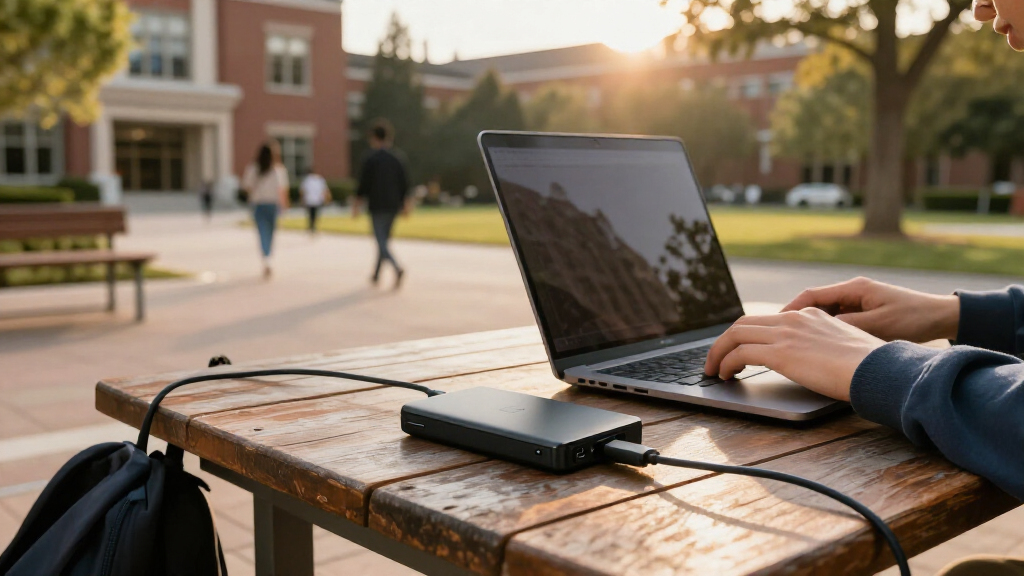
I ranked these drives around student realities: carrying a drive between classes, moving assignments and project files, backing up a laptop, and keeping enough room for work across a school year. I weighed stated capacity, advertised interface and speed, portability, construction, and how readily each model appears to fit common student tasks. I gave more weight to practical everyday usefulness than to a high speed figure that may depend on compatible host hardware.
The order reflects how broadly useful each option is, not a claim that one drive suits every student. Models with a balanced combination of capacity and straightforward use rank ahead of very small drives or options whose advantages serve narrower needs. Large-capacity and rugged choices earn their place for specific workloads, while budget-oriented or compact models rank lower when their limited capacity could create a near-term upgrade need. Product names can cover different variants, so I recommend checking the exact model, capacity, cable, and interface before buying.
| portable solid state drives for student | Write speed |
|---|---|
| SanDisk 1TB Portable SSD | — |
| Western Digital 1TB My Passpor | — |
| Vansuny 250GB Portable Externa | Up to 350 MB/s |
| Netac ZSlim 250GB Portable SSD | Up to 450 MB/s |
| SanDisk Extreme Portable SSD | — |
| SSK Portable SSD 250GB Externa | Up to 1000 MB/s |
| SanDisk 2TB Extreme Portable S | Up to 1000 MB/s |
| Verbatim Pocket 512GB External | Up to 1000 MB/s |
| Samsung T9 Portable SSD 1TB | Up to 1950 MB/s |
| Western Digital 1TB My Passpor | Up to 1000 MB/s |
| SanDisk 500GB Portable SSD | — |
| ADATA SD810 500GB Portable Ext | — |
| Samsung T7 Portable SSD 1TB Ti | Up to 1000 MB/s |
| Samsung T5 Portable SSD 500GB | — |
| SanDisk 1TB Portable SSD | — |
Factors to Consider When Choosing Portable Solid State Drives For Students
For a student, the right portable SSD is the one that fits both the work and the routine around it. I would start with the files you actually keep, then check whether your laptop can use the drive’s connection and speed. These broader choices can prevent buying too little capacity, paying for performance you cannot use, or relying on one drive as your only copy.
Choose Capacity Around Your Workload, Not Just This Semester
Documents, presentations, and spreadsheets take far less space than raw video, photo libraries, virtual machines, and large creative projects. A 250GB drive may be enough for a focused set of current assignments, but it leaves less room for backups and accumulating coursework. Students handling media or keeping files from multiple terms should compare 1TB and 2TB options before deciding. Leave working space free rather than planning to fill every gigabyte; a nearly full drive is harder to organize and less useful as a backup destination. Check the size of your current laptop files and estimate what you will add over the next year. That quick calculation is more useful than choosing capacity by price or appearance alone.
Match the Connection to Your Laptop
A drive’s maximum advertised speed depends on the port, cable, and computer connected to it. A faster interface will not make an older or slower port transfer files at the drive’s headline rate. Before paying extra for a high-speed model, identify the ports on your laptop and check which cables are included. USB-C describes a connector shape, not a guarantee of a particular transfer speed, so check the interface specification too. Compatibility matters especially for students who use campus lab computers or borrow devices, where available ports may differ. For routine documents and backups, dependable compatibility can be more useful than the highest stated speed.
Treat Advertised Speed as a Workflow Benefit, Not a Trophy
Fast transfers matter most when you regularly move large video files, photo catalogs, or other heavy project folders. For smaller coursework files, the time saved may be minor compared with the cost of buying a drive and host setup built for higher throughput. Sustained performance can also differ from a brief advertised maximum, so avoid assuming that every long transfer will run at peak speed. Think about how often you move large batches and whether you work directly from the external drive. If your usual task is making a weekly backup, ease of connection and enough space may deserve higher priority. A premium speed tier makes more sense when it removes a real bottleneck in your routine.
Account for Campus Carry and Handling
A drive that travels in a backpack faces bumps, pressure, and occasional exposure to dust or moisture. If you move between classrooms, a sturdier design may offer peace of mind, but do not assume that a rugged-looking case makes a drive waterproof or indestructible. Check the exact protection claims and conditions for the specific model. Compact drives are easy to pack, yet very small designs can be easier to misplace and their connectors may need more careful handling. A short cable or protective pouch can also affect how convenient a drive is to use at a crowded desk. Choose physical protection to match your routine rather than paying for protection you are unlikely to need.
Build a Backup Plan That Does Not Depend on One Drive
An external SSD can make backups convenient, but keeping the only copy of an assignment on a portable drive leaves it exposed to loss, damage, or failure. Keep important work in at least two places, such as your laptop plus an external drive, with a separate cloud or institutional backup where available. Confirm that your backup process includes the folders you care about and runs often enough for your coursework. Capacity planning should account for the backup copy, not only files you want to carry between classes. Students handling sensitive research or personal data should also check encryption and account-access options before storing it. A backup is useful only when files can be restored, so periodically open a few saved files to confirm the process works.
Check the Details Behind Similar Product Names
This lineup includes several SanDisk Portable SSD listings and multiple WD and Samsung families, so a familiar name alone does not identify the exact version. Compare the listed capacity, model generation, interface, included cable, and any protection claims on the specific product page. Bundled accessories and naming can vary between listings, even when two products appear similar. Older models may still suit basic storage tasks, but their connection and speed may differ from newer alternatives. Confirm that your computer supports the connection you plan to use, especially if a drive advertises a higher-speed interface. This small check can prevent a mismatch between the drive you expect and the one that arrives.
Frequently Asked Questions
Is 250GB enough for a student portable SSD?
It can be enough if you mainly carry documents, presentations, and a limited set of current assignments. It is less suitable as a broad laptop backup or as a home for large video, photography, or design projects. The 250GB Vansuny, Netac, and SSK options are best viewed as focused storage choices rather than long-term all-purpose campus drives. Estimate the size of your existing files and leave room for new work before choosing. If you expect your coursework to grow, a larger drive may save you from splitting files across devices.
Should I choose the Samsung T9 or a less specialized SSD for coursework?
The T9 makes more sense when you regularly move large files and have a computer and cable that support its USB 3.2 Gen 2×2 connection. Most students working with documents, slides, and ordinary backups are unlikely to need its maximum advertised speed. A broadly compatible option such as the Samsung T7 may be a simpler fit for everyday school tasks. Check your laptop’s port specifications rather than assuming every USB-C port supports the faster interface. The right choice depends on whether large transfers are a recurring bottleneck or an occasional task.
Do I need a rugged SSD for carrying it around campus?
Not every student does, but extra physical protection can matter if the drive spends most of its time loose in a backpack or travels outdoors. The SanDisk Extreme models are more relevant to that kind of carry, while a compact or standard portable SSD can suit careful desk-to-class use. Rugged design does not replace a backup, and protection claims vary by model. Check the exact product’s dust, water, and impact specifications before relying on them. A pouch and consistent storage spot may be enough for a student whose drive stays inside a laptop sleeve.
Can one portable SSD back up my laptop and carry class files?
Yes, but separate the backup and working files so that one does not crowd out the other. Choose enough capacity for the laptop folders you plan to back up plus the files you want to carry, with extra room for growth. Keep another copy of important work somewhere separate, since one portable drive can be lost or damaged. Check that your backup software can use the drive and that its file format works with every computer you need to connect. If you handle private student or research data, review encryption options before storing it.
Which drive makes sense if I want something small but still need room for projects?
The Verbatim Pocket 512GB offers a middle ground in this roundup: it has more capacity than the 250GB mini drives while emphasizing a compact form. Whether that is enough depends on the size of your projects and whether you will also store a laptop backup. For large media files or several semesters of work, a 1TB option may be a better balance even if it takes up slightly more space. Check the drive’s connector and cable setup against your laptop before choosing a pocket-sized model. Small size is convenient, but it should not come at the expense of usable capacity.
Conclusion
For most students, I recommend the Samsung T7 Portable SSD 1TB as the best overall because it offers a practical balance for everyday coursework and file storage. The SanDisk 1TB Portable SSD models and select compact listings are worth comparing for students who want a straightforward everyday or smaller carry option, while the 250GB drives are my value-minded picks only for light, limited storage needs. For a premium workload, choose the Samsung T9 when your computer supports its faster interface, or the SanDisk Extreme 2TB when capacity and a more rugged carry matter more. Beginners should favor a 1TB model with a connection that matches their laptop and avoid paying extra for speed their setup cannot use. For large media libraries, prioritize 2TB; for frequent campus travel, weigh physical protection; and for small document collections, a compact 512GB or 250GB drive can be enough. Match the capacity and connection to your actual work, and keep important files in a second location.