
TL;DR

Prime made for students and young adults
- Fast, free delivery for dorm and study essentials
- Prime Video and Amazon Music included
- Member-only deals
NASA’s Curiosity rover encountered blocks covered with small disc-shaped features while working in a sulfate-rich area of Mars, then drove to a promising drill workspace. The team selected a target for contact science and a possible drilling campaign that could supply material to CheMin, the rover’s mineral-identification instrument.
NASA’s Curiosity rover examined rocks covered with small, disc-shaped features and selected a nearby drill target during the operations described in a Sept. 30 mission update. A planned drilling campaign could provide material for CheMin, the rover’s X-ray diffraction instrument, which can identify minerals in collected rock powder.
In the NASA Science blog, planetary scientist Lucy Lim said Curiosity’s workspace changed from the finely layered bedrock blocks seen in recent work in the sulfate unit to blocks “covered (and likely filled)” with a jumble of small discs. The team imaged the blocks, named Yungay and Chiu Chiu, using Mastcam and the arm-mounted MAHLI camera. It also planned composition measurements with ChemCam’s laser-induced breakdown spectroscopy instrument, or LIBS, and the APXS instrument.
The shapes have more than one possible explanation. Lim wrote that they could reflect the growth pattern of a particular crystalline mineral, or could be fragments of a harder rock layer that broke up and collected in the area. The team planned observations to examine both their appearance and composition; the blog does not report a final identification.
Curiosity then drove to a promising drill workspace a short distance beyond the disc-featured blocks. The rover had traveled more than a kilometer since its previous drill site at Campo Marte, and this would be its first drill site above the erosional supersurface, according to the update. The team selected a specific target and planned a short drive to put it within reach of the rover’s arm, followed by contact science and, if those steps went well, a preload test and drilling.
A Drill Could Identify the Minerals
The unusual shapes are scientifically interesting, but images alone cannot settle what made them. The possible drill campaign matters because it could deliver a sample for CheMin’s X-ray diffraction analysis, giving the team a way to identify minerals in the target rather than relying only on surface appearance or remote measurements.
The observations also fit into Curiosity’s broader study of how rocks formed and changed in this part of Mars. Mineral composition and rock textures can help scientists assess the conditions under which the materials formed. The blog does not say what any future analysis will find, or that the disc-shaped features themselves are the selected drill target.
As an affiliate, we earn on qualifying purchases.
From Disc-Shaped Blocks to Drill Site
The update covers planning for sols 5016–5021, with the Earth planning date given as Friday, Sept. 18, 2026. Lim noted that Curiosity had encountered somewhat similar features earlier in the mission near Pahrump Hills, in the Murray mudstones. She also said comparable shapes occur in some Earth rocks, particularly in settings where minerals precipitate from evaporating fluids. These comparisons provide possibilities, not proof of how the Mars features formed.
Alongside the close-up work, the team continued long-distance imaging of buttes on either side of Valle Grande. ChemCam’s remote imager and Mastcam mosaics were planned to show layers in the buttes and help map sedimentary structures in upcoming units. Images of more recent erosional deposits were also intended to help the team investigate how Valle Grande formed.
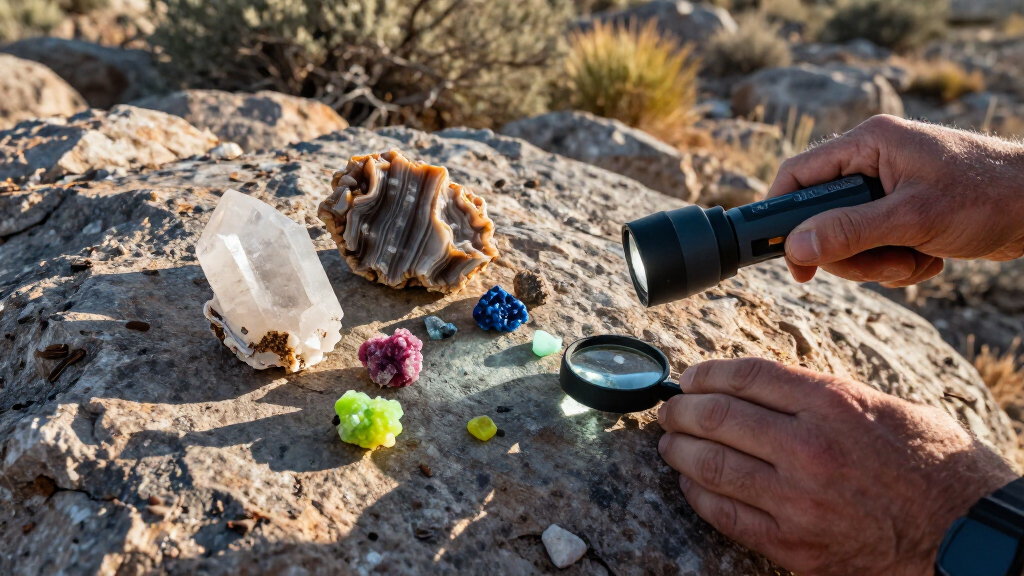
X-ray diffraction mineral testing kit
As an affiliate, we earn on qualifying purchases.
As an affiliate, we earn on qualifying purchases.
The Shapes Still Need Identification
The NASA update does not identify the disc-shaped features or report the results of the planned composition measurements. It remains unclear whether they formed in place as crystals or arrived as fragments from another layer. The blog also describes drilling as conditional: the rover was to conduct contact science and a preload test before proceeding, “if all goes well.” It does not confirm that drilling took place or that CheMin received a sample.
The update names a selected drill target but does not provide a mineral result, sample analysis, or a timeline for completing the campaign. The relationship between the nearby unusual blocks and the target also remains unspecified.
As an affiliate, we earn on qualifying purchases.
Contact Checks Precede Drilling
The next planned step was to bring the selected target within reach of Curiosity’s arm for contact science. If that work and a preload test were successful, the team planned to drill. Lim said she would return to planning for “Drill Sol 1,” described as triage contact science, and the blog left the outcome open. Further updates would be needed to confirm whether the rover completed the drill sequence and whether a sample was analyzed by CheMin.
As an affiliate, we earn on qualifying purchases.
Key Questions
What did Curiosity find?
The rover encountered blocks covered with small disc-shaped features in its sulfate-unit workspace. Their origin was not determined in the NASA update.
What might have formed the disc-shaped features?
NASA scientist Lucy Lim said they could be shaped by the growth of a crystalline mineral, or could be fragments of a harder rock layer that broke apart and collected there. These were possibilities, not confirmed explanations.
Why is Curiosity planning to drill?
A drill sample could be analyzed by CheMin, Curiosity’s X-ray diffraction instrument, which the blog says is needed to identify minerals.
Has Curiosity drilled the new target?
The Sept. 30 blog describes a selected target and planned contact checks, a preload test, and drilling if conditions allowed. It does not confirm that drilling or sample analysis occurred.
Source: primary
Halloween Picks
halloween
As an affiliate, we earn on qualifying purchases.