For most dorm rooms, I’d start with the Igloo 3.2 cu. ft. Compact Mini Fridge: its separate freezer and larger storage space make it a practical all-rounder. The EUHOMY 3.2 Cu. Ft. Two-Door is another strong fit if you want a two-door layout, while the Midea 1.6 Cu. Ft. Mini Refrigerator suits tighter spaces where a reversible door helps with placement. The main tradeoff is between compact size and useful capacity, especially if you want a freezer for frozen meals or ice. Thermoelectric and beverage-focused models serve narrower needs than a conventional food fridge. Read on for how I’d match each pick to a dorm setup.

Prime made for students and young adults
- Fast, free delivery for dorm and study essentials
- Prime Video and Amazon Music included
- Member-only deals
Key Takeaways
- Separate freezer space is the clearest dividing line: the 3.2 cu. ft. two-door models suit students storing frozen meals, while many compact single-door picks prioritize chilled items.
- The Igloo 3.2 cu. ft. model is my best overall fit for students who want room for groceries plus a freezer without choosing a specialty design.
- Reversible-door models solve a practical dorm problem: the EUHOMY, Frestec, and Midea compact options can better fit rooms where furniture limits door swing.
- Portable thermoelectric fridges are a different tool: the Frigidaire 4 L and 10 L options suit personal items and short-term use, not the food-storage role of a standard dorm fridge.
- Capacity labels do not tell the whole story: beverage-focused and compact models can have useful niches, but students should check usable shelf space and freezer layout against what they actually store.
| Frigidaire EFMIS171 Retro Portable Mini Fridge, 4 L, Green |  | Best Portable Personal Pick | Capacity: 4 liters; up to six 12 oz cans | Dimensions: 10 × 7 × 10.5 inches | Weight: 3 pounds | VIEW LATEST PRICE | See Our Full Breakdown |
| Igloo 3.2 cu. ft. Compact Mini Fridge with Freezer |  | Best for Simple Frozen Storage | Capacity: 3.2 cu. ft. | Configuration: Single door, freezer on top | Cooling range: 32–50°F | VIEW LATEST PRICE | See Our Full Breakdown |
| EUHOMY 3.2 Cu. Ft. Two-Door Mini Fridge with Freezer, Silver |  | Best Two-Door Dorm Setup | Total capacity: 3.2 cu. ft. | Fresh-food capacity: 2.24 cu. ft. | Freezer capacity: 0.96 cu. ft. | VIEW LATEST PRICE | See Our Full Breakdown |
| EUHOMY 1.7 Cu. Ft. Compact Mini Fridge with Reversible Door, Black |  | Best Compact Under-Desk Pick | Capacity: 1.7 cu. ft. | Main compartment: 1.5 cu. ft. | Additional compartment: 0.2 cu. ft. | VIEW LATEST PRICE | See Our Full Breakdown |
| Frestec 1.7 Cu. Ft. Compact Mini Fridge with Reversible Door, Black |  | Best Small Fridge with Flexible Shelving | Capacity: 1.7 cu. ft. | Fresh-food capacity: 1.5 cu. ft. | Freezer capacity: 0.2 cu. ft. | VIEW LATEST PRICE | See Our Full Breakdown |
| Frigidaire EFR176 Retro Compact Refrigerator, 1.6 cu. ft., Coral |  | Best for Retro Style | Capacity: 1.55 cu. ft. (marketed as 1.6 cu. ft.) | Dimensions: 16 x 18 x 18.5 in. (D x W x H) | Cooling method: Compressor | VIEW LATEST PRICE | See Our Full Breakdown |
| Frigidaire 10L Portable Thermoelectric Mini Fridge, Black Stainless Steel |  | Best Portable Personal Cooler | Capacity: 10 L | Can capacity: Up to 15 standard 12 oz cans | Cooling method: Thermoelectric | VIEW LATEST PRICE | See Our Full Breakdown |
| Upstreman FR17 1.7 Cu. Ft. Compact Mini Fridge with Freezer, Black |  | Best Compact Pick with a Freezer | Capacity: 1.7 cu. ft. (46 L refrigerator net capacity) | Dimensions: 17.7 x 18.9 x 19.3 in. (D x W x H) | Temperature range: 33.8°F to 46.4°F | VIEW LATEST PRICE | See Our Full Breakdown |
| Feelfunn 24-Can Beverage Refrigerator, 18 L, Black |  | Best for Dorm Room Drinks | Capacity: 0.6 cu. ft. (18 L) | Can capacity: 22–24 cans (330 ml) | Temperature range: 40°F–61°F | VIEW LATEST PRICE | See Our Full Breakdown |
| Upstreman BR321 3.2 Cu. Ft. Mini Fridge with Freezer, Black |  | Best for Grocery Storage | Total capacity: 3.2 cu. ft. | Refrigerator capacity: 2.9 cu. ft. | Freezer capacity: 0.3 cu. ft. | VIEW LATEST PRICE | See Our Full Breakdown |
| DEMULLER 45L Double-Door Mini Fridge with Freezer, Silver |  | Best for Separate Freezer Storage | Capacity: 2.39 cu. ft. (45 L) | Freezer capacity: 0.8 cu. ft. | Dimensions: 14.6″ D × 14.9″ W × 30.8″ H | VIEW LATEST PRICE | See Our Full Breakdown |
| Frigidaire EFR331 Compact Refrigerator with Erasable Blackboard Front, 3.2 cu. ft., Black |  | Best for Shared Dorm Organization | Capacity: 3.2 cu. ft. | Configuration: Single door with chiller compartment | Shelves: 2 adjustable shelves | VIEW LATEST PRICE | See Our Full Breakdown |
| Midea 1.6 Cu. Ft. Mini Refrigerator with Reversible Door |  | Best for Tight Desk-Side Spaces | Capacity: 1.6 cu. ft. | Dimensions: 17.72″ W × 18.58″ D × 19.37″ H | Temperature range: 28.4°F to 35.6°F | VIEW LATEST PRICE | See Our Full Breakdown |
| Frostorm 3.2 Cu. Ft. Mini Fridge with Freezer |  | Best for Frozen Treats and Ice | Total capacity: 3.2 cu. ft. (91 L) | Freezer capacity: About 0.35 cu. ft. | Dimensions: 18.9″ D × 17.2″ W × 32.7″ H | VIEW LATEST PRICE | See Our Full Breakdown |
| Midea 1.7 Cu. Ft. Compact Refrigerator with Adjustable Thermostat and Reversible Door |  | Best Freezerless Efficient Pick | Capacity: 1.7 cu. ft. | Dimensions: 17.6″ D × 18.6″ W × 19.3″ H | Weight: 28.8 lb | VIEW LATEST PRICE | See Our Full Breakdown |
| dorm room mini fridge | Capacity | Dimensions | Noise level |
|---|---|---|---|
| Frigidaire EFMIS171 Retro Port | 4 liters; up to six 12 oz cans | 10 × 7 × 10.5 inches | — |
| Igloo 3.2 cu. ft. Compact Mini | 3.2 cu. ft. | — | — |
| EUHOMY 3.2 Cu. Ft. Two-Door Mi | — | 18.9 × 18.1 × 33.5 inches (D × W × H) | 40 dB |
| EUHOMY 1.7 Cu. Ft. Compact Min | 1.7 cu. ft. | 16.9 × 17.5 × 19.1 inches (D × W × H) | Less than 38 dB |
| Frestec 1.7 Cu. Ft. Compact Mi | 1.7 cu. ft. | 16.73 × 17.83 × 19.8 inches (D × W × H) | 37 dB |
| Frigidaire EFR176 Retro Compac | 1.55 cu. ft. (marketed as 1.6 cu. ft.) | 16 x 18 x 18.5 in. (D x W x H) | — |
| Frigidaire 10L Portable Thermo | 10 L | — | — |
| Upstreman FR17 1.7 Cu. Ft. Com | 1.7 cu. ft. (46 L refrigerator net capacity) | 17.7 x 18.9 x 19.3 in. (D x W x H) | 38 dB |
| Feelfunn 24-Can Beverage Refri | 0.6 cu. ft. (18 L) | 11.2 x 14.9 x 16.7 in. (W x D x H) | ≤38 dB |
| Upstreman BR321 3.2 Cu. Ft. Mi | — | 17.4 x 18.7 x 33.1 in. (D x W x H) | 38 dB |
| DEMULLER 45L Double-Door Mini | 2.39 cu. ft. (45 L) | 14.6" D × 14.9" W × 30.8" H | 38 dB |
| Frigidaire EFR331 Compact Refr | 3.2 cu. ft. | — | — |
| Midea 1.6 Cu. Ft. Mini Refrige | 1.6 cu. ft. | 17.72" W × 18.58" D × 19.37" H | Less than 42 dB |
| Frostorm 3.2 Cu. Ft. Mini Frid | — | 18.9" D × 17.2" W × 32.7" H | — |
| Midea 1.7 Cu. Ft. Compact Refr | 1.7 cu. ft. | 17.6" D × 18.6" W × 19.3" H | — |
More Details on Our Top Picks
Frigidaire EFMIS171 Retro Portable Mini Fridge, 4 L, Green
The Frigidaire EFMIS171 is the choice for a student who needs a personal stash of drinks or snacks and wants to move it between a dorm room and a car. At 3 pounds and just 10 inches wide, it takes up far less space than the room-sized Igloo 3.2 cu. ft. Compact Mini Fridge with Freezer. Its six-can capacity makes that portability a tradeoff: it cannot handle grocery storage or replace a full dorm fridge. Unlike the Igloo, it can also warm contents, and its home and 12V adapters expand where it can be plugged in. Cooling reaches up to 32°F below the surrounding temperature, so a warm room can limit how cold it gets. Choose it for personal portions and flexible placement; skip it if you need reliably cold, larger-volume storage.
Pros:- Weighs 3 pounds and includes a carrying handle for easy relocation
- Includes adapters for standard home outlets and 12V car outlets
- Can warm contents as well as cool them
- Removable shelf helps fit different small items
Cons:- Four-liter capacity is too small for groceries or shared dorm storage
- Cooling performance depends on the surrounding temperature
Best for: Students who want a lightweight personal drink and snack fridge that can also travel by car
Not ideal for: Students storing groceries, meal prep, or frozen food, since its 4-liter interior holds only personal portions
- Capacity:4 liters; up to six 12 oz cans
- Dimensions:10 × 7 × 10.5 inches
- Weight:3 pounds
- Cooling method:Thermoelectric
- Cooling:Up to 32°F below ambient temperature
- Warming:Up to 140°F
- Power:110V home outlet or 12V car outlet
- Included accessories:AC adapter and DC car adapter
Our verdict“Pick this for portable, personal portions; choose a larger compressor fridge such as the Igloo if you need dorm food storage.”
Igloo 3.2 cu. ft. Compact Mini Fridge with Freezer
For a student who wants both chilled food and a place for frozen items, the Igloo 3.2 cu. ft. provides a straightforward step up from personal mini fridges. Its separate freezer compartment and 3.2 cubic feet of total storage give it more everyday utility than the Frigidaire EFMIS171, which is limited to six cans and small foods. Glass shelves, bottle racks, and can storage help keep dorm staples organized, while the mechanical thermostat keeps controls simple. The freezer is still part of a compact single-door unit, so it is not a substitute for a full-size freezer. The left-oriented door may also constrain placement in a tight room. This suits students who value basic chilled and frozen storage over flexible door positioning.
Pros:- Separate freezer compartment accommodates some frozen foods
- Mechanical thermostat adjusts across a 32–50°F refrigerator range
- Glass shelves and dedicated bottle and can storage help organize supplies
- Compact freestanding format suits dorm rooms and offices
Cons:- Freezer space is limited within the compact single-door design
- Left-oriented door may not work well in every room layout
Best for: Students who want a straightforward dorm fridge with organized drink storage and a separate compartment for frozen staples
Not ideal for: Students whose room layout requires a right-opening or reversible door, or who need a full-size freezer
- Capacity:3.2 cu. ft.
- Configuration:Single door, freezer on top
- Cooling range:32–50°F
- Cooling method:Compressor, static cooling with no fan
- Temperature control:Adjustable mechanical thermostat
- Shelves:Two glass shelves
- Door storage:Two door shelves
- Door orientation:Left
Our verdict“Choose the Igloo for uncomplicated dorm food storage with a freezer compartment, provided its left-opening door fits your room.”
EUHOMY 3.2 Cu. Ft. Two-Door Mini Fridge with Freezer, Silver
The EUHOMY CRF006-31 makes the most sense for a student who wants distinct refrigerator and freezer compartments with more placement flexibility. Its reversible door is a practical advantage over the Igloo 3.2 cu. ft. Compact Mini Fridge with Freezer, whose door is left-oriented. The EUHOMY also separates its 0.96 cu. ft. freezer from the 2.24 cu. ft. fresh-food section behind two doors, making access and organization more straightforward. Its three temperature settings keep operation simple, though they offer less fine control than the Igloo’s adjustable mechanical thermostat. At 40 dB, it is not silent, and the freezer remains modest in size. This is a good fit when a dorm layout and separate compartments matter more than maximizing freezer capacity.
Pros:- Separate doors distinguish refrigerator and freezer storage
- Reversible door adapts to different dorm layouts
- Adjustable glass shelves support flexible food organization
- Compact freestanding dimensions suit small rooms
Cons:- Freezer capacity is limited to 0.96 cu. ft.
- Three temperature settings provide less adjustment than a continuously adjustable thermostat
- Listed noise level is 40 dB
Best for: Students who want separate fresh-food and freezer doors and need to choose the door swing for their room
Not ideal for: Students who need generous freezer capacity or quieter operation for a light-sleeping room
- Total capacity:3.2 cu. ft.
- Fresh-food capacity:2.24 cu. ft.
- Freezer capacity:0.96 cu. ft.
- Dimensions:18.9 × 18.1 × 33.5 inches (D × W × H)
- Temperature settings:Three levels
- Refrigerator range:32–50°F
- Freezer temperature:As low as -7.6°F
- Door orientation:Reversible
- Noise level:40 dB
Our verdict“Choose the EUHOMY for flexible placement and separate compartments; the Igloo offers a simpler adjustable thermostat.”
EUHOMY 1.7 Cu. Ft. Compact Mini Fridge with Reversible Door, Black
When floor space is tight, the EUHOMY RF006-16 offers a compact way to keep a small supply of food and drinks close by. Its 16.9 × 17.5 × 19.1-inch footprint is easier to fit under a desk or beside a bed than the taller 3.2 cu. ft. EUHOMY two-door model. A reversible door helps adapt it to the room, and removing the wire shelf makes room for taller items. Its 1.7 cu. ft. capacity is the clear compromise: it suits daily essentials, not a week of shared groceries. The extra 0.2 cu. ft. compartment is also quite small, so it should not be treated as a full freezer. Compared with the similar-capacity Frestec, this model lists quieter operation, but has just one removable shelf.
Pros:- Compact dimensions suit under-desk or countertop placement
- Reversible door allows flexible positioning
- Removable wire shelf creates room for taller items
- Listed noise level is below 38 dB
Cons:- 1.7 cu. ft. capacity limits grocery storage
- The additional compartment is only 0.2 cu. ft.
Best for: Students with limited floor space who need a small everyday supply of drinks, snacks, or a few groceries
Not ideal for: Roommates sharing groceries or students who need meaningful freezer space
- Capacity:1.7 cu. ft.
- Main compartment:1.5 cu. ft.
- Additional compartment:0.2 cu. ft.
- Dimensions:16.9 × 17.5 × 19.1 inches (D × W × H)
- Temperature range:32–50°F
- Energy consumption:0.55 kWh per day
- Noise level:Less than 38 dB
- Door orientation:Reversible
Our verdict“Pick this compact EUHOMY for a quiet, flexible spot for daily essentials, but choose the 3.2 cu. ft. model for shared groceries.”
Frestec 1.7 Cu. Ft. Compact Mini Fridge with Reversible Door, Black
The Frestec FTC16RE gives students a small refrigerator with more shelf flexibility than the EUHOMY RF006-16. Its removable glass shelves can make room for taller containers, and the reversible door and adjustable feet help it fit into awkward dorm layouts. The listed 37 dB noise level is close to the EUHOMY’s below-38 dB figure, so neither has a clear quietness advantage from the stated specs. Frestec lists six temperature modes, including a low setting of 28.4°F, but that range does not make its 0.2 cu. ft. freezer a substitute for substantial frozen-food storage. With just 1.7 cu. ft. overall, it is better for one student’s essentials than for shared groceries. Automatic defrosting and a detachable door seal may simplify upkeep, though the compact capacity remains the main limit.
Pros:- Removable glass shelves accommodate taller items
- Reversible door and adjustable feet help with placement
- Six temperature modes provide several adjustment choices
- Automatic defrosting and detachable door seal support maintenance
Cons:- The 0.2 cu. ft. freezer compartment offers little frozen-food space
- Total capacity of 1.7 cu. ft. is limited for shared storage
- Listed temperature range extends down to 28.4°F, so settings need careful selection for fresh food
Best for: Students who want a small fridge with removable glass shelves for taller containers and flexible placement
Not ideal for: Students who store frozen meals regularly or need room to stock groceries for multiple people
- Capacity:1.7 cu. ft.
- Fresh-food capacity:1.5 cu. ft.
- Freezer capacity:0.2 cu. ft.
- Dimensions:16.73 × 17.83 × 19.8 inches (D × W × H)
- Temperature settings:Six modes; 28.4–50°F
- Shelves:Three listed; removable glass shelves
- Energy consumption:0.55 kWh per day; 200 kWh per year
- Noise level:37 dB
- Door orientation:Reversible
Our verdict“Choose the Frestec over the similar-sized EUHOMY if removable glass shelving matters most, while keeping expectations modest for freezer space.”
Frigidaire EFR176 Retro Compact Refrigerator, 1.6 cu. ft., Coral
The coral retro design gives this Frigidaire a distinct look in a dorm where a basic black box may feel out of place. Its 1.55 cu. ft. interior, removable shelves, and door storage handle drinks and everyday snacks, while the internal chiller compartment adds a spot for items that need colder storage. Compared with the Upstreman FR17, it trades a dedicated top freezer for a bottle opener, an ice cube tray, and a more decorative finish. The reversible door and leveling legs make placement easier in a tight room. The tradeoff is modest capacity and manual defrosting, so it suits students stocking a small selection rather than full weekly groceries. I would skip it if freezer space matters more than style.
Pros:- Coral retro finish adds a distinctive look to a dorm room
- Reversible door and leveling legs allow flexible placement
- Removable shelves and door storage help organize bottles and snacks
- Built-in bottle opener and ice cube tray add convenience
Cons:- 1.55 cu. ft. capacity is limited for groceries or shared use
- Manual defrosting requires occasional upkeep
- Internal chiller is not a substitute for a dedicated freezer
Best for: Students who want a compact, colorful fridge for drinks and snacks and value retro styling in a small dorm room
Not ideal for: Students who need a dedicated freezer or room to store groceries for several days
- Capacity:1.55 cu. ft. (marketed as 1.6 cu. ft.)
- Dimensions:16 x 18 x 18.5 in. (D x W x H)
- Cooling method:Compressor
- Defrost:Manual
- Shelves:2 removable shelves
- Door:Reversible, single door
- Additional features:Internal chiller compartment, adjustable thermostat, side-mounted bottle opener, ice cube tray
Our verdict“Choose this Frigidaire for retro style and dorm staples if a small chiller compartment is enough in place of a dedicated freezer.”
Frigidaire 10L Portable Thermoelectric Mini Fridge, Black Stainless Steel
At 10 liters and 6 pounds, this Frigidaire is easy to move between a dorm desk and a car, making it a personal cooler rather than a small kitchen refrigerator. It holds up to 15 cans and can also warm items, a flexibility the Feelfunn 24-Can Beverage Refrigerator does not offer. The removable shelf helps separate smaller snacks or skincare from drinks, and the home and 12V power options suit students who travel between campus and home. Its main limitation is temperature: thermoelectric cooling reaches about 32°F below the surrounding temperature, so a warm room can reduce how cold the contents get. The capacity also falls well short of the Feelfunn or the larger Upstreman models. I would choose it for personal use and portability, not as the room’s main food fridge.
Pros:- Lightweight 6-pound body with carrying handle
- Runs from a home outlet or a 12V car adapter
- Can cool or warm contents
- Removable shelf and door shelves help organize small items
Cons:- Cooling depends on ambient temperature
- 10-liter capacity is too small for shared or substantial food storage
- Right-hand door orientation is not listed as reversible
Best for: Students who want a lightweight personal cooler for a desk, dorm room, or car and may use its warming mode
Not ideal for: Students storing perishable groceries or needing dependable refrigerator temperatures in a warm room
- Capacity:10 L
- Can capacity:Up to 15 standard 12 oz cans
- Cooling method:Thermoelectric
- Cooling performance:Up to 32°F below ambient temperature
- Warming performance:Up to 140°F at 75°F ambient temperature
- Power options:110V home outlet and 12V car adapter
- Weight:6 lbs
- Features:Carrying handle, locking latch, removable shelf, automatic defrost
Our verdict“Pick this Frigidaire for portable personal cooling and warming, but choose a compressor model such as the Feelfunn for steadier dorm-room drink storage.”
Upstreman FR17 1.7 Cu. Ft. Compact Mini Fridge with Freezer, Black
The Upstreman FR17 is a space-conscious choice for students who want a small refrigerator with a separate freezer compartment. At 17.7 inches deep and 18.9 inches wide, it fits tighter spots than the taller Upstreman BR321, while its reversible door gives more flexibility beside a desk or bed. Five temperature settings and a 38 dB noise rating suit shared sleeping spaces, and the freezer can make ice cubes. That freezer is limited, though: the product data says it is not intended for ice cream, so it should not be treated as full frozen-food storage. With 1.7 cu. ft. total capacity and manual defrost, it also offers less refrigerator room than the BR321. I’d pick it when a compact footprint and basic freezer access matter more than stocking a larger range of food.
Pros:- Compact footprint suits tight dorm layouts
- Separate top freezer can make ice cubes
- Five temperature settings allow cooling adjustment
- Reversible door and 38 dB operation suit flexible room placement
Cons:- Freezer is not intended for storing ice cream
- Manual defrost requires periodic maintenance
- Less refrigerator space than the taller Upstreman BR321
Best for: Students with limited floor space who want a compact fridge, adjustable cooling, and a small compartment for ice cubes
Not ideal for: Students who need reliable frozen-food storage, ice cream storage, or room for larger grocery hauls
- Capacity:1.7 cu. ft. (46 L refrigerator net capacity)
- Dimensions:17.7 x 18.9 x 19.3 in. (D x W x H)
- Temperature range:33.8°F to 46.4°F
- Temperature settings:5
- Noise level:38 dB
- Energy consumption:204 kWh annually
- Configuration:Freezer on top
- Defrost:Manual
Our verdict“Choose the FR17 when compact dimensions and a basic ice-making compartment matter more than freezer performance or extra refrigerator capacity.”
Feelfunn 24-Can Beverage Refrigerator, 18 L, Black
For students whose dorm fridge is mainly a drink station, the Feelfunn’s 18-liter interior is arranged around cans and bottles rather than mixed groceries. It holds up to 24 standard cans, has a removable shelf, and adds a display and interior LED that make it easy to find a drink without turning on the room lights. Its compressor cooling and 38 dB-or-lower noise rating make it a more suitable stationary beverage fridge than the portable thermoelectric Frigidaire 10L, especially where room temperature varies. The tradeoff is a narrow 40°F to 61°F range, which may be too warm for items requiring colder storage. At 20.4 pounds and with manual defrost, it is less convenient to move and maintain than the Frigidaire. I’d skip it if you need a general-purpose fridge or a freezer.
Pros:- Fits up to 24 standard 330 ml cans in a compact footprint
- Compressor cooling is better suited to steady room use than a thermoelectric personal cooler
- Removable shelf accommodates different drink sizes
- Interior LED and touch display are convenient in low light
Cons:- 40°F minimum may not suit items needing colder storage
- No freezer compartment
- Manual defrosting and 20.4-pound weight limit convenience
Best for: Students who mostly chill canned drinks and want a quiet, dedicated beverage fridge for a desk or dorm corner
Not ideal for: Students who need colder storage for perishables, freezer space, or a lightweight unit to carry between locations
- Capacity:0.6 cu. ft. (18 L)
- Can capacity:22–24 cans (330 ml)
- Temperature range:40°F–61°F
- Cooling method:Compressor
- Noise level:≤38 dB
- Dimensions:11.2 x 14.9 x 16.7 in. (W x D x H)
- Weight:20.4 lbs
- Features:Removable shelf, interior LED, touch controls with LED display
Our verdict“Choose the Feelfunn for a quiet, can-focused dorm drink fridge, but look to a compact refrigerator such as the Upstreman FR17 for more general food storage and freezer access.”
Upstreman BR321 3.2 Cu. Ft. Mini Fridge with Freezer, Black
The Upstreman BR321 gives dorm residents more room for everyday food than the compact FR17, with 2.9 cu. ft. for refrigeration, two adjustable glass shelves, and a crisper drawer. Its 0.3 cu. ft. freezer adds a separate space, but the product data warns that it is not suitable for ice cream or ice cubes; students should treat it as limited freezer storage rather than a full freezer. At 33.1 inches tall, it needs floor space where the shorter FR17 could fit under some desks or counters. The 38 dB operation and Energy Star certification make it appealing for a bedroom, while the reversible door helps with tight layouts. Manual defrost remains a chore. I’d rank it for students prioritizing refrigerated groceries, but skip it if a strong freezer is a deciding factor.
Pros:- 2.9 cu. ft. refrigerator section provides more grocery space than the FR17
- Crisper drawer and adjustable glass shelves support varied food storage
- 38 dB operation suits bedrooms and shared rooms
- Energy Star certified and has a reversible door
Cons:- 0.3 cu. ft. freezer is not suitable for ice cream or ice cubes
- Manual defrost requires periodic upkeep
- 33.1-inch height takes more vertical room than the FR17
Best for: Students who keep groceries, produce, and drinks in their room and can spare floor space for a taller unit
Not ideal for: Students with very limited vertical space or anyone who needs a freezer for ice cream and ice cubes
- Total capacity:3.2 cu. ft.
- Refrigerator capacity:2.9 cu. ft.
- Freezer capacity:0.3 cu. ft.
- Dimensions:17.4 x 18.7 x 33.1 in. (D x W x H)
- Temperature settings:5 adjustable levels, 32°F to 50°F
- Noise level:38 dB
- Energy certification:Energy Star certified
- Defrost:Manual
Our verdict“Choose the BR321 for more refrigerated grocery space and a crisper drawer, provided its small freezer and taller footprint fit your dorm needs.”
DEMULLER 45L Double-Door Mini Fridge with Freezer, Silver
Separate doors and a dedicated freezer make this DEMULLER a practical pick for a dorm student who wants frozen items apart from chilled drinks and snacks. Its 2.39 cu. ft. capacity is roomier than the Midea 1.6 Cu. Ft. Mini Refrigerator, while its footprint stays compact at 14.9 inches wide. The freezer reaches -0.4°F, giving it a clearer frozen-food role than a small chiller compartment, though its capacity is still limited for stocking full meals. Two removable shelves let me adjust the refrigerator space for taller containers. The tradeoff is manual defrost and a knob-based thermostat, which offer fewer conveniences than automatic controls. At 38 dB, it is designed for personal spaces, but students sensitive to appliance noise may still notice it.
Pros:- Separate freezer and refrigerator compartments simplify food organization
- Compact 14.9-inch width can fit a narrow dorm space
- Two removable shelves allow flexible refrigerator storage
- 38 dB compressor is designed for quieter personal spaces
Cons:- 0.8 cu. ft. freezer limits how much frozen food it can hold
- Manual defrost requires periodic maintenance
- Seven-level knob control lacks automatic temperature adjustment
Best for: Dorm students who want a dedicated freezer for a few frozen staples alongside everyday chilled food
Not ideal for: Students who need ample frozen-food storage or want automatic temperature controls and defrosting
- Capacity:2.39 cu. ft. (45 L)
- Freezer capacity:0.8 cu. ft.
- Dimensions:14.6″ D × 14.9″ W × 30.8″ H
- Temperature control:7-level manual thermostat
- Freezer temperature:Down to -0.4°F
- Noise level:38 dB
- Defrost:Manual
- Doors:2
Our verdict“Choose the DEMULLER if a dedicated freezer matters more than maximum capacity or low-maintenance operation.”
Frigidaire EFR331 Compact Refrigerator with Erasable Blackboard Front, 3.2 cu. ft., Black
The 3.2 cu. ft. interior and writable front give this Frigidaire a useful combination for shared dorm rooms: there is more space for drinks and snacks than in the DEMULLER 45L, and the blackboard surface can hold reminders or a roommate’s name. Two adjustable glass shelves, a can rack, and a 2L bottle basket help keep common items sorted. Its reversible door and flush-back design also make placement easier when furniture limits the available approach. The chiller compartment and ice tray add short-term cold storage, but this is a single-door layout, so it does not offer the separate freezer access of the Frostorm 3.2 Cu. Ft. Mini Fridge. Manual defrost is another recurring chore, and the chiller should not be mistaken for a roomy freezer.
Pros:- Writable, erasable front can hold reminders or personal notes
- Two adjustable glass shelves accommodate different food containers
- Bottle basket and can rack keep popular drinks organized
- Reversible door and flush-back design support flexible placement
Cons:- Manual defrost requires periodic upkeep
- Chiller compartment is not equivalent to a separate freezer
- 3.2 cu. ft. may be limiting for students storing groceries for several people
Best for: Roommates who want a shared snack-and-drink fridge with a visible place for notes and reminders
Not ideal for: Students who need a separate freezer compartment or want to avoid manual defrosting
- Capacity:3.2 cu. ft.
- Configuration:Single door with chiller compartment
- Shelves:2 adjustable shelves
- Door storage:2L bottle basket and can rack
- Door:Reversible
- Defrost:Manual
- Cooling method:Compressor
- Additional features:Writable front, ice cube tray, built-in bottle opener
Our verdict“Pick the EFR331 for shared chilled storage and a useful message surface, provided a full freezer is not a priority.”
Midea 1.6 Cu. Ft. Mini Refrigerator with Reversible Door
For a student who mainly needs cold drinks, snacks, and a little chiller space, this 1.6 cu. ft. Midea is easier to fit beside a desk than larger choices such as the Frigidaire EFR331. Its removable glass shelf can come out for taller or irregularly shaped items, and the door rack holds a 2-liter bottle. A reversible door helps when the room layout dictates which way it can open. The separate chiller compartment offers some flexibility, but the listed temperature range is narrow and this small unit cannot match the DEMULLER’s dedicated, larger freezer section. It also requires manual defrosting. With annual energy use listed at 207 kWh, buyers can compare its stated consumption with the Midea 1.7 Cu. Ft. model, listed at 246 kWh, while noting their cooling methods differ.
Pros:- Small 1.6 cu. ft. capacity suits a desk-side or bedroom setup
- Reversible door supports different room layouts
- Removable glass shelf makes space for taller items
- Door rack accommodates a 2-liter bottle
Cons:- Limited capacity is poorly suited to shared or bulk food storage
- Chiller compartment does not provide the storage of a dedicated freezer
- Manual defrost requires periodic upkeep
Best for: Students with limited floor space who mostly chill drinks and small portions of food
Not ideal for: Students who store frozen meals regularly or need room for shared groceries
- Capacity:1.6 cu. ft.
- Dimensions:17.72″ W × 18.58″ D × 19.37″ H
- Temperature range:28.4°F to 35.6°F
- Annual energy consumption:207 kWh/year
- Noise level:Less than 42 dB
- Shelf:1 removable glass shelf
- Door:Single, reversible
- Defrost:Manual
Our verdict“Choose this Midea for compact chilled storage when fitting the room matters more than freezer capacity.”
Frostorm 3.2 Cu. Ft. Mini Fridge with Freezer
The Frostorm pairs 3.2 cu. ft. of refrigerator space with a small freezer compartment, making it a better fit for students who want room for chilled groceries plus ice or a few short-term frozen items. Its freezer is listed at roughly 0.35 cu. ft., so it is more limited than the DEMULLER’s 0.8 cu. ft. compartment; that makes this Frostorm a choice for occasional frozen storage rather than stocking meals. Two adjustable shelves and door bins help organize the main compartment, and a reversible door can make a tight dorm layout easier to work with. The mechanical thermostat keeps operation straightforward, but manual defrost adds maintenance. At 32.7 inches tall and 40.7 pounds, it also needs a stable spot with enough clearance to open the door.
Pros:- 3.2 cu. ft. capacity provides more chilled storage than the 1.6 cu. ft. Midea
- Separate freezer can hold ice and a small amount of short-term frozen food
- Two adjustable shelves and door bins support flexible organization
- Reversible door works with different room layouts
Cons:- Freezer is small at about 0.35 cu. ft.
- Manual defrost requires periodic maintenance
- 40.7-pound weight makes frequent repositioning less convenient
Best for: Students who want a larger chilled-food area and only need freezer space for ice or occasional short-term storage
Not ideal for: Students who rely on frozen meals or want a compact unit that is easy to move often
- Total capacity:3.2 cu. ft. (91 L)
- Freezer capacity:About 0.35 cu. ft.
- Dimensions:18.9″ D × 17.2″ W × 32.7″ H
- Weight:40.7 lb
- Freezer temperature:-6°F to -11°F
- Energy consumption:0.6 kWh per day
- Thermostat:Mechanical, settings 1–5
- Defrost:Manual
Our verdict“Choose the Frostorm if chilled capacity is the priority and its small freezer is enough for ice and occasional frozen items.”
Midea 1.7 Cu. Ft. Compact Refrigerator with Adjustable Thermostat and Reversible Door
This freezerless 1.7 cu. ft. Midea makes sense for students who want everyday chilled storage and do not need frozen food in the room. It is slightly larger than the Midea 1.6 Cu. Ft. Mini Refrigerator, while its ENERGY STAR certification gives efficiency-conscious buyers a clear point of distinction. The 2-liter bottle door shelf and removable, adjustable shelf help it handle common dorm staples without taking up the space of the 3.2 cu. ft. Frostorm. Its reversible door also gives more flexibility beside a bed or desk. The tradeoff is decisive: there is no freezer compartment, so ice and frozen meals need another solution. The product data lists thermoelectric cooling, unlike the compressor method specified for the other Midea, and manual defrost remains part of upkeep.
Pros:- ENERGY STAR certification supports an efficiency-focused choice
- 1.7 cu. ft. freezerless layout provides dedicated chilled storage
- Reversible door supports flexible placement
- Removable shelf and 2-liter bottle storage suit common dorm items
Cons:- No freezer compartment for ice or frozen food
- Manual defrost requires periodic upkeep
- Listed annual energy consumption is 246 kWh
Best for: Energy-conscious students who want a compact refrigerator for drinks and fresh snacks without needing frozen storage
Not ideal for: Students who keep ice, frozen meals, or other freezer items in their dorm room
- Capacity:1.7 cu. ft.
- Dimensions:17.6″ D × 18.6″ W × 19.3″ H
- Weight:28.8 lb
- Energy certification:ENERGY STAR
- Annual energy consumption:246 kWh
- Cooling method:Thermoelectric
- Configuration:Freezerless
- Door:Single, reversible
Our verdict“Pick this Midea when efficient, compact chilled storage fits your routine and you can do without a freezer.”
How We Picked
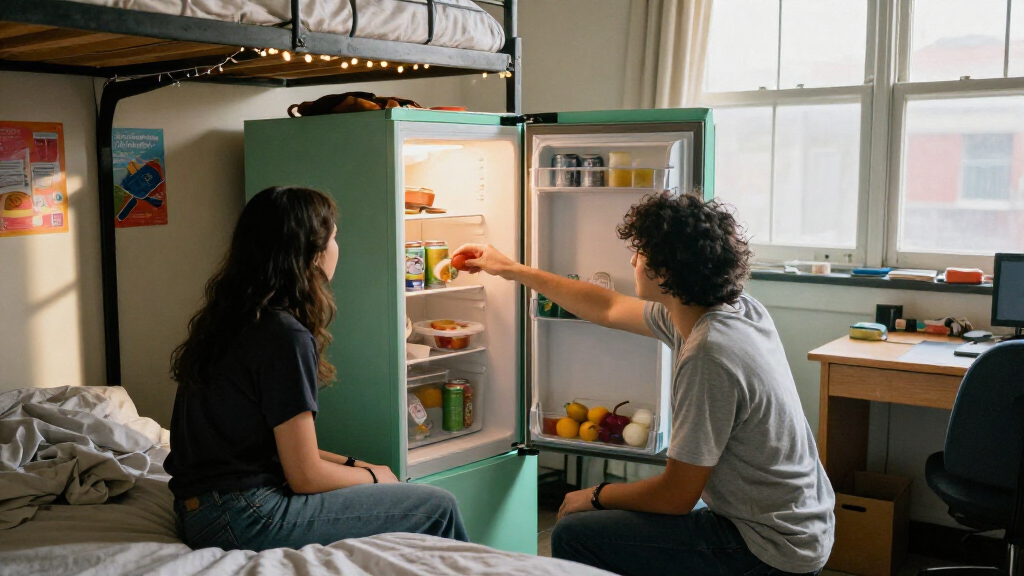
I ranked these for dorm room use, weighing usable capacity, freezer access, footprint, door flexibility, and the kind of storage each design supports. A conventional fridge with enough room for everyday food earned a higher place than a portable cooler or beverage unit, since those formats address narrower needs. Within the standard compact group, reversible doors and a practical freezer layout improve fit in rooms where space is shared or constrained.
The ranking also reflects tradeoffs that affect daily use: a larger two-door model can store more but takes more floor space; a small unit is easier to place but may not handle groceries for a full week. I considered maintenance and usability, including accessible shelves and whether a product’s design is suited to food storage or mainly drinks and personal items. Since the listed products provide no comparable measured noise, energy, or temperature data, I have not used those as ranking claims; students should check those details and campus rules before buying.
Factors to Consider When Choosing Dorm Room Mini Fridges
I’d choose a dorm fridge by starting with the room, the food routine, and the campus rules. A capacity number alone can hide whether the layout will work for your storage habits.
Measure the Space and Door Swing
Measure the spot where the fridge will sit, including height under shelves or desks and room for the door to open. Leave space for ventilation according to the manufacturer’s instructions, since pushing a fridge tightly against furniture can interfere with heat dissipation. Check whether the door opens toward a wall, bed, or walkway; a reversible door can help, but confirm that its hinge can actually be switched during installation. Think about access to the outlet too, so the cord does not cross a walking path. A model that technically fits but blocks a drawer or closet will feel oversized in everyday use. If you share a room, agree on placement before delivery.
Match Capacity to Your Shopping Routine
Estimate what you keep cold at one time rather than shopping by the biggest capacity number. Someone storing drinks, yogurt, and snacks may prefer a small unit that leaves floor space available, while weekly grocery storage calls for more usable shelf room. Tall bottles, meal containers, and produce need different shapes of space, so inspect the interior layout when available. A nominal capacity can include areas that do not fit the items you buy most. Avoid sizing up just in case if the larger body makes the room harder to use. If you regularly share food with a roommate, count those items before choosing.
Decide Whether You Need a Real Freezer
A freezer compartment is useful for frozen meals, ice, or ingredients you want to keep longer, but its presence does not tell you how much usable frozen storage it provides. Small internal compartments can be better for a few essentials than for stocking several meals. If frozen food is a routine part of your diet, compare the compartment’s shape and access rather than treating every freezer label as equivalent. If you mostly refrigerate snacks and drinks, a freezer may consume space you would rather use for chilled items. Confirm that the unit’s operating instructions describe the temperatures and use you need. Campus rules may also limit which appliances or freezer formats are allowed.
Check Campus Rules Before Ordering
Colleges can set limits on refrigerator size, wattage, or the number of appliances allowed in a room. Read the current housing policy and ask residence staff if its wording is unclear; product names and marketing categories do not establish whether a model is allowed. Check whether the policy applies to total exterior dimensions, capacity, or electrical draw. Roommate arrangements may also affect how many units are permitted. Save the product specifications so you can compare the actual model with the policy. Doing this before delivery can prevent a difficult return or an appliance you cannot use.
Treat Noise and Energy Use as Verification Points
Noise matters more when a refrigerator sits beside a bed or a desk used for studying. Because comparable sound measurements are not provided across this lineup, look for a manufacturer’s decibel specification or check the manual before deciding. Energy use also affects long stays and shared electrical circuits, so compare the annual consumption label when available rather than inferring efficiency from size. Ask residence staff about outlet limits and whether extension cords are prohibited. A quiet-room priority may outweigh extra capacity if the fridge will run within arm’s reach. These checks are especially useful when two models otherwise appear similar.
Choose a Format That Matches the Job
Standard compressor refrigerators, thermoelectric portable units, and beverage-focused coolers solve different storage problems. A personal portable fridge can make sense for a few items or a specialized use, but it is not a direct substitute for a conventional dorm food fridge. Beverage-oriented designs may give drinks convenient access while offering less flexibility for meal containers or groceries. Before buying a specialty format, write down the items you expect to store and how often you will restock. If the list includes frozen meals or varied groceries, prioritize a conventional fridge with an appropriate compartment. A narrow use case can justify a specialty unit when it fits campus rules and your available space.
Frequently Asked Questions
Is a 1.6 or 1.7 cu. ft. fridge enough for a dorm room?
It can be enough if you mainly keep drinks, snacks, and a few refrigerated staples, and you shop or eat meals elsewhere. It is less suited to storing a week of groceries, especially if you need space for tall bottles or meal containers. Check the interior layout and the size of any freezer compartment, since advertised capacity does not show how much room each area gives you. If you share the fridge, plan around both people’s regular items before choosing the smaller size. A compact model saves floor space, but that benefit matters only if its storage matches your routine.
Should I choose a two-door fridge with a freezer?
Choose a two-door model if you expect to keep frozen meals, ice, or other frozen items on hand and have room for the larger footprint. The separate door makes freezer access distinct from the refrigerator section, which can be more convenient than a small internal compartment. Check the freezer’s usable dimensions before assuming it will hold a particular meal box or container. If you rarely freeze food, a single-door model may leave more room for chilled items and occupy less space. Campus size or appliance rules should settle the question if they limit larger units.
Are portable thermoelectric mini fridges a good main dorm fridge?
They are generally better suited to a small personal stash than to everyday grocery storage. The 4 L and 10 L Frigidaire options in this roundup are much smaller than the conventional compact refrigerators, so they do not offer the same storage role. Before using one as your primary unit, check its stated temperature range, capacity, and operating guidance for the items you plan to keep inside. Consider how often you would need to restock and whether you also need a freezer. For a student storing varied meals and groceries, a standard compact refrigerator is the more practical format.
What should I check before placing a dorm fridge near my bed?
Check published noise information, the required ventilation clearance, and the route to a suitable outlet. The products here do not provide a consistent set of measured sound levels, so model-to-model noise comparisons need manufacturer data. Review the college’s electrical rules and avoid relying on an extension cord unless housing guidance permits it. Place the unit where the door can open without hitting the bed or blocking a walkway. If you are sensitive to background sound, ask whether your school has a recommended appliance list or consult the manufacturer before buying.
How do I know whether a mini fridge is allowed in my residence hall?
Read the residence hall’s appliance policy for limits on size, capacity, electrical draw, and freezer features. Policies differ, so a model allowed at one college may not meet another school’s rules. Compare the policy with the exact product specifications, including the model number, rather than relying on the broad label “mini fridge.” If the policy is ambiguous, ask housing staff before ordering and keep their guidance for reference. This check can also clarify whether roommates may have separate units or must share one.
Conclusion
For a standard dorm setup, I’d choose the Igloo 3.2 cu. ft. Compact Mini Fridge as the best overall because it pairs everyday storage with a separate freezer. For a similar two-door arrangement, the EUHOMY 3.2 Cu. Ft. Two-Door is another candidate; compare its layout and fit with the Igloo before deciding. Students seeking a smaller conventional fridge can look at the Midea 1.6 Cu. Ft. or reversible-door EUHOMY 1.7 Cu. Ft. as value-minded, space-conscious options, while the reversible door makes the EUHOMY easier to place in some rooms. For beginners who want a straightforward food-storage format, I’d start with a standard compact model and confirm campus rules before considering specialty designs. Choose the Frigidaire 4 L or 10 L for a narrow personal-storage need, or the Feelfunn beverage refrigerator if drink access is your main priority. I can’t assign a meaningful premium pick from the supplied product details alone; compare verified build, noise, energy, and layout specifications before paying more for a particular model.